

Refrigerator Ice Maker Not Working: 6 Symptoms, 5 First Checks and 5 Causes of No Ice
What Does an Ice Maker Not Working Look Like?
An ice maker is not working when it makes no ice, small or hollow ice, fused cubes, a jam, noise or a leak. This page covers ice makers built into a refrigerator, not freestanding ice machines. The table below matches six symptoms to their likely meaning.
| Symptom | What it indicates |
|---|---|
| No ice | A fill, freeze or harvest fault |
| Small or hollow ice | Low water flow into the mold |
| Fused cubes | Melt and refreeze from temperature swings |
| Jammed ice maker | Cubes blocking the ejector or a module fault |
| Noise | Valve fill sounds, grinding or a motor fault |
| Leaking | Overflow or a frozen fill tube |
A dispenser that fails to dispense ice is a separate fault, covered in refrigerator water dispenser not working.

What Should You Check First When the Ice Maker Is Not Working?
Five first checks resolve many ice maker complaints before any part is replaced.
Safety notice: Unplug the refrigerator before touching any part behind a panel. Shut off the water at the shutoff valve before touching the line or the valve. Electrical testing, refrigerant handling and sealed-system work belong to a technician.
- Confirm that the ice maker is switched on and that the wire arm is down.
- Read a freezer thermometer to confirm the freezer is cold enough.
- Confirm that the freezer door closes fully.
- Confirm that the water line is connected and that the shutoff valve is open.
- Confirm that the water filter is fully seated.
Allow the time stated in the manual after each change, because the ice maker cycle is slow. The ideal refrigerator temperature settings explain the freezer setpoint.
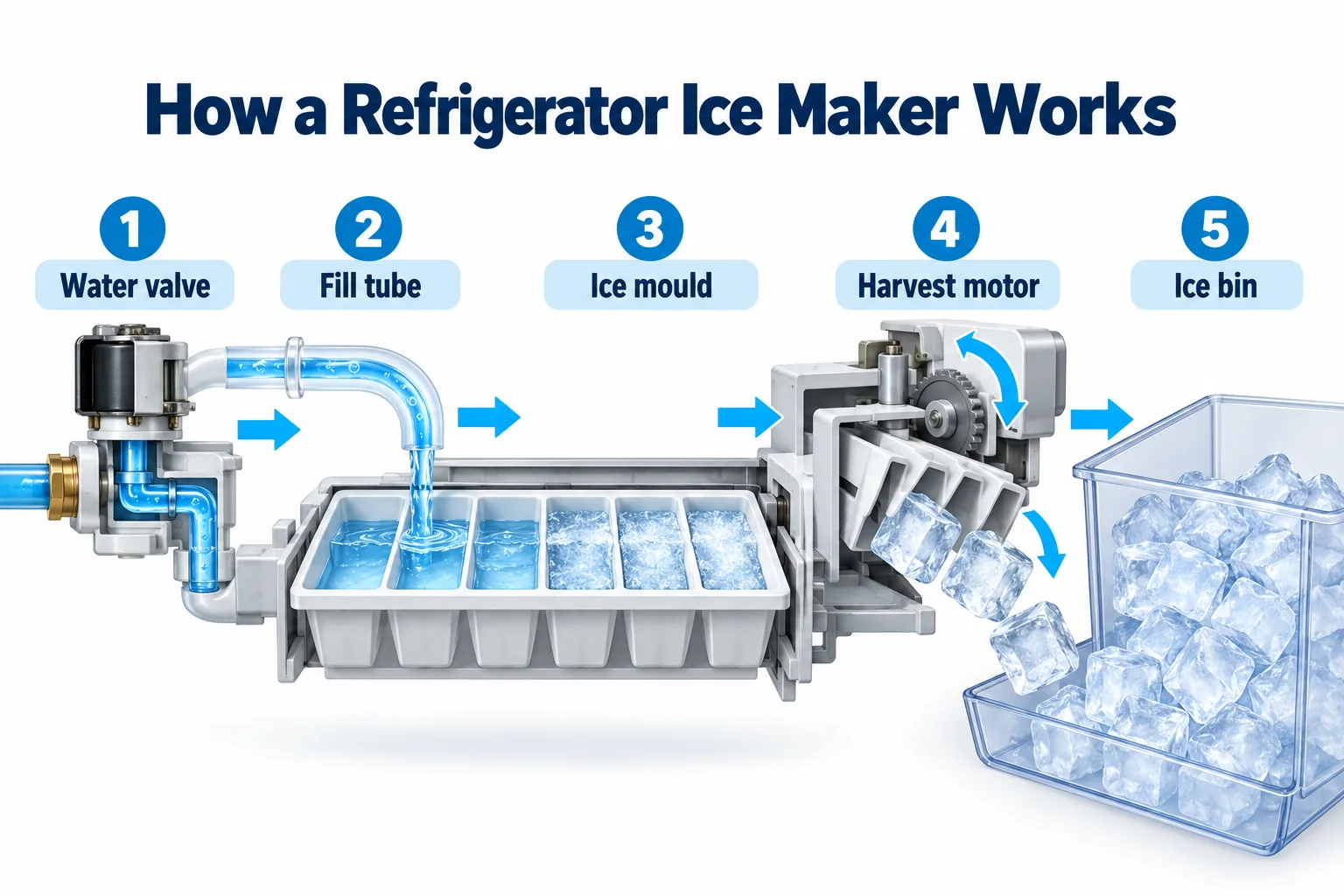
How Does an Ice Maker Work?
An ice maker fills a mold with water, freezes it and ejects the cubes into the bin in a repeating cycle. Four parts run the cycle. The inlet valve admits water through the fill tube. The mold holds the water while it freezes. A small heater loosens the cubes. An ejector pushes the cubes into the bin until the arm or sensor signals that the bin is full. A raised arm therefore stops ice production. Water that does not freeze and cubes that do not release stop the cycle at different points. The cooling that freezes the cubes is explained in how a refrigerator cools.
No Ice: Which Fault Is It?
Five causes stop ice production, and each carries a difficulty label.
| Cause | Sign | Test | Difficulty |
|---|---|---|---|
| Frozen fill tube | No water reaches the mold | Thaw the tube with the unit unplugged | Easy to moderate |
| Inlet valve | No water, or water when none is requested | Technician tests the solenoid with a meter | Moderate |
| Low water pressure | Small or hollow ice | Check the line, the shutoff valve and the filter | Easy |
| Ice maker module | Water and temperature are correct, but no cycle | Technician tests the module | Moderate |
| Freezer too warm | Water fills but does not freeze | Read a freezer thermometer | Easy |
Is the fill tube frozen?
A frozen fill tube blocks the water that fills the mold. Unplug the refrigerator and thaw the tube. Difficulty: easy to moderate.
Is the inlet valve failing?
A failed inlet valve passes no water to the ice maker, or passes water when none is requested. A technician tests the solenoid with a meter and the manufacturer specification. Replace a valve that fails the test. Difficulty: moderate. A leaking valve is covered in refrigerator leaking water.
Is the water pressure low?
Low water pressure under-fills the mold or keeps the valve from opening fully. Check the line for kinks, the shutoff valve for a partly closed position and the filter for clogging. Call a plumber for low pressure in the house line. Difficulty: easy.
Is the ice maker module failing?
A failed ice maker module stops the cycle even when the water and the temperature are correct. A technician tests the heater and the motor against the manufacturer specification. Replace the module after the test confirms the fault. Difficulty: moderate.
Is the freezer too warm?
A freezer that is too warm stops the water from freezing into cubes. Read a freezer thermometer. If the whole refrigerator is warm, read refrigerator not cooling. Difficulty: easy.
Why Is the Ice Small, Hollow or Slow?
Small, hollow or slow ice points to low water flow or a freezer that is too warm. Four causes are common:
- Low water pressure at the shutoff valve or in the line
- A partly frozen fill tube
- A clogged or overdue water filter
- A freezer temperature that is too high
Low pressure leaves the mold under-filled, which produces small or hollow cubes. A partly frozen fill tube delivers a trickle, which slows each cycle. A clogged filter restricts the flow in the same way, and a warm freezer slows the freezing. Check the causes in this order: pressure, tube, filter and temperature. Change one item at a time and wait for the time stated in the manual before judging the result.
Why Is the Ice Fused, Jammed, Bad-Tasting or Smelly?
Fused, jammed, bad-tasting or smelly ice comes from melt and refreeze, odors in the freezer or an unclean bin. Four causes explain most cases:
- Melt and refreeze, which fuses cubes into a block when temperatures swing or the ice sits unused
- Odors from open food in the freezer, which the ice absorbs
- An unclean bin, which holds old residue
- Old ice, which absorbs odors over time
Empty the bin, wash it with mild soap and water, dry it and discard the old ice. Cover open food in the freezer. Replace the water filter on the schedule in the manual. Fused cubes break apart after the bin is emptied and the freezer temperature stabilizes. A jammed ejector needs the bin emptied and the arm returned to the down position. Bad taste usually traces to the bin or the filter, so clean the bin first.
Which Brand and Type Pages Cover Your Ice Maker?
Brand and layout change the ice maker parts, the reset steps and the error codes. Reset steps come from the manufacturer documentation, and the general sequence is in how to reset a refrigerator. Use the guide for your brand or type. Each brand guide lists the faults documented for that brand, the reset steps and the codes. French door and side-by-side models place the ice maker in different locations, and the manual shows the exact location.
By brand:
- GE refrigerator problems
- Samsung refrigerator problems
- LG refrigerator problems
- Frigidaire refrigerator problems
- Whirlpool refrigerator problems
By type:
- French door refrigerator problems
- Side-by-side refrigerator problems
- Top-freezer, bottom-freezer and mini refrigerator problems
When Should You Replace the Part or Call a Technician?
Replace a failed ice maker module or valve after a test confirms the fault, and call a plumber or a technician for water-line work beyond the refrigerator. A module swap is a moderate repair, and the water shutoff valve stays closed during any module or valve work. Ask the technician for a written quote that separates parts and labor. Use only the filter type listed in the manual. The line between home work and technician work is explained in refrigerator repair: DIY or professional. Compare the repair quote with the age of the refrigerator, as explained in repair or replace a refrigerator.
What Do People Also Ask About an Ice Maker Not Working?
Why is my new refrigerator not making ice yet?
A new refrigerator needs time to reach temperature and fill the water line before the first ice, as the manual states. The settling steps are in refrigerator startup and settling.
Why is my ice maker leaking?
A frozen fill tube, an overflowing mold or a leaking inlet valve makes the ice maker leak, as explained in refrigerator leaking water.
Why is my ice maker noisy?
A short buzz is normal when the valve fills the mold, and grinding or repeated clicking points to a fault, as explained in refrigerator noises.
Why does my ice maker work and then stop?
An ice maker that works and then stops points to a frozen fill tube, a warm freezer or a failing module.
Why is my ice maker making small cubes?
Small cubes point to low water pressure, a partly frozen fill tube or a clogged filter.