
Refrigerator Noises: 9 Sounds, 5 Sources and 5 Simple Checks
What Do Normal Refrigerator Sounds Sound Like?
A refrigerator normally hums, gurgles, clicks and pops at times, and a sound becomes a fault when it is new, loud, constant or paired with poor cooling. The table below lists six normal sounds and their usual causes.
| Normal sound | Usual cause |
|---|---|
| Soft hum while cooling | Compressor and fans running |
| Gurgling or bubbling | Refrigerant flowing after the compressor stops |
| Popping or crackling | Panels expanding and contracting as temperatures change |
| Dripping or sizzling | Meltwater reaching the defrost heater |
| Click at the start or end of cooling | Relay or thermostat switching |
| Ice dropping into the bin | Ice maker harvest |
The sections below cover sounds that fall outside this list.
Which Sound Are You Hearing?
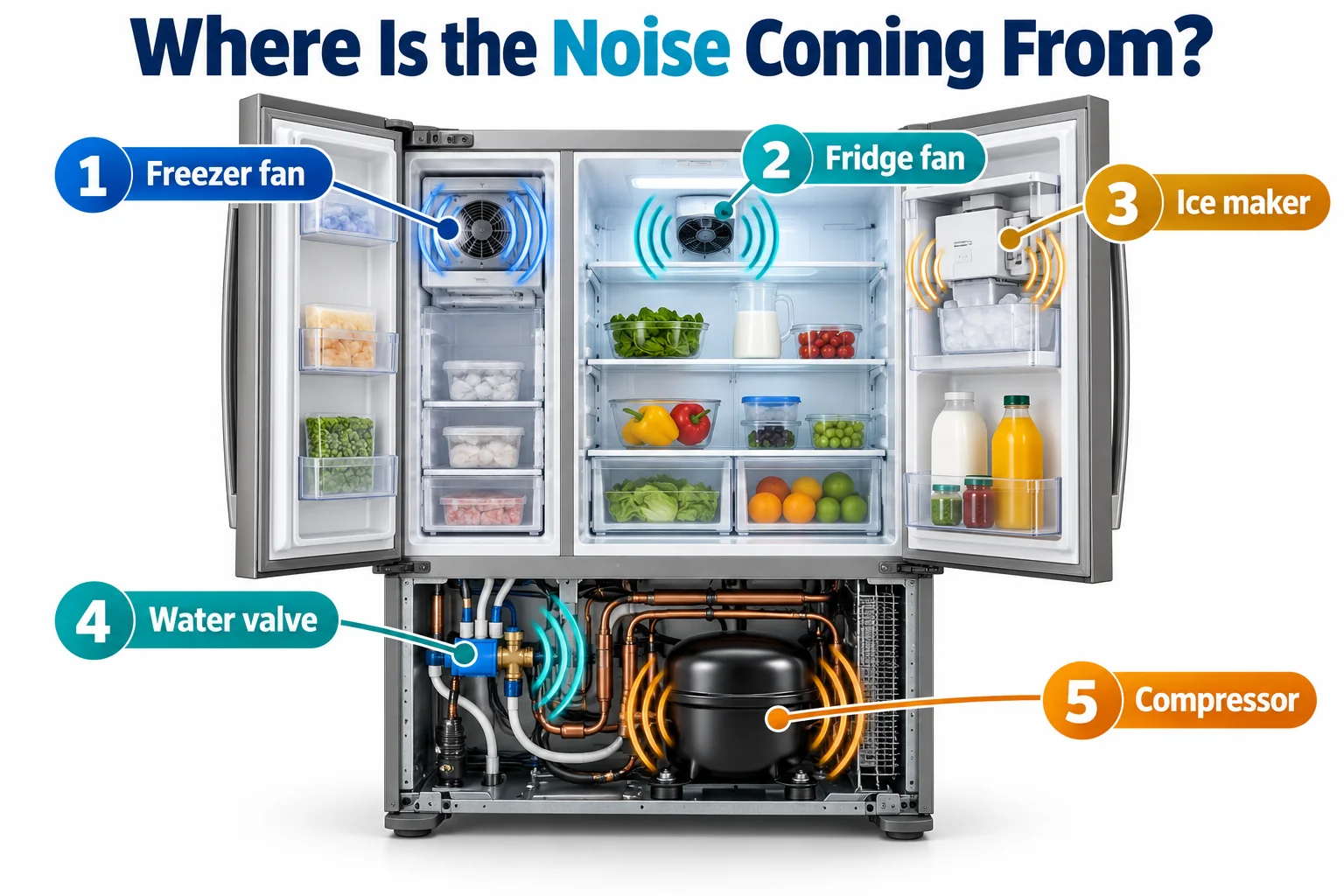
Each sound points to a short list of sources, and the table below matches nine sounds to their likely causes.
| Sound | Likely source | Where to look next |
|---|---|---|
| Buzzing | Water valve filling, compressor or start relay | Ice maker or water valve, compressor or start relay |
| Humming | Compressor or a fan, normal when soft | Fan, compressor or start relay |
| Clicking | Start relay, defrost timer or ice maker | Compressor or start relay, defrost, ice maker |
| Rattling | Loose pan, items touching or a fan blade | Simple checks, fan |
| Squealing | Fan motor bearing | Fan |
| Gurgling | Refrigerant flow or water in the drain | Normal sounds, defrost |
| Popping | Panel expansion or defrost heating | Normal sounds, defrost |
| Grinding | Ice maker or a failing fan motor | Ice maker, fan |
| Loud vibration | Unlevel unit or contact with a wall | Simple checks |
Does the sound follow the compressor?
A sound that stops when the compressor stops usually comes from the compressor, the relay or a fan, and a sound that continues points to the ice maker, the defrost system or a loose part. Note whether the sound starts and stops with the cooling cycle.
How do you locate the source of the sound?
Listen at the back, the bottom and the freezer while the compressor runs, because the loudest position shows the source. Switch the ice maker off for a short test to remove its sound from the list. Stay clear of moving fan blades and hot parts.
How do you describe the sound to a technician?
Record a short video that shows when the sound starts, how long it lasts and whether the cooling is normal. Add the time of day and whether the ice maker or the dispenser was in use.
Is It Something Simple Like Leveling or Contact?
Five simple checks remove many noises before any part is tested.
Safety notice: Unplug the refrigerator before touching any part at the back or the bottom. Stop at the checks below. Electrical testing, refrigerant handling and sealed-system work belong to a technician.
- Level the refrigerator by adjusting the front feet until both doors close without help.
- Pull the refrigerator slightly from the wall and confirm that nothing touches the back or the sides.
- Remove items from the top of the unit and from the vents.
- Confirm that the drain pan under the unit sits firmly in place.
- Check that the back panel and the covers are secured.
A unit that was moved recently needs time to settle, as explained in refrigerator startup and settling.
Is It a Fan?
A fan fault produces squealing, rattling or grinding that follows the cooling cycle. Two fans move air, and each sits in a different place. Test either fan by confirming, with the unit unplugged, that the blades turn freely by hand.
Is the evaporator fan making the noise?
A noisy evaporator fan sounds like rattling or squealing from behind the freezer back panel. Ice on the blades or a worn bearing, for example, causes the noise. Clear any ice with the unit unplugged. Replace a motor that stays noisy. Difficulty: moderate. The noise causes are in refrigerator evaporator fan noise.
Is the condenser fan making the noise?
A noisy condenser fan sounds like rattling or buzzing near the compressor at the back or the bottom. Dust, debris or a bent blade, for example, causes the noise. Clean the area with the unit unplugged. Replace a motor that stays noisy. Difficulty: moderate.
Is It the Compressor or the Start Relay?
Clicking or humming that repeats without cooling points to the start relay or the compressor. Both parts sit at the back or the bottom of the unit, and both need a technician to confirm the fault. Repeated clicking and loud humming both mean that the compressor is not starting normally.
Is the start relay clicking?
A failing start relay clicks every few minutes while the compressor fails to start. A technician tests the relay with a meter. Replace the relay if it fails the test. Difficulty: moderate. Testing and replacement are in refrigerator start relay.
Is the compressor humming loudly?
A compressor that hums loudly without starting, or that runs loudly and shuts off, is failing. The signs and testing limits are in refrigerator compressor problems. Difficulty: technician-only. Ask the technician for a written quote that separates parts and labor.
Is It the Ice Maker or the Water Valve?
The ice maker and the water valve make short, predictable sounds, and a sound that changes or repeats points to a fault. Three sounds are typical:
- A short buzz when the water valve fills the ice maker
- A rumble and a thud when ice drops into the bin
- A grinding sound while the dispenser crushes ice
A valve that drips or hisses can also leak, as explained in refrigerator leaking water. A jammed ice maker is covered in refrigerator ice maker not working.
Is It the Defrost System?
Popping, crackling and dripping during the defrost cycle are normal, and loud or constant popping with frost build-up points to a defrost fault. Two sounds are typical:
- Popping as the evaporator coils warm and the metal expands
- Sizzling as meltwater reaches the heater
Frost on the freezer back wall points to a failed part, as explained in refrigerator frost and defrost problems.

When Is a Noise Dangerous or Urgent?
A burning smell, sparks or grinding followed by no cooling needs the refrigerator unplugged immediately. Four signs are urgent:
- A burning or electrical smell
- Sparks or smoke
- Grinding followed by no cooling
- A hot cord or outlet
Unplug the refrigerator at the outlet if it is safe to reach. Call emergency services for smoke or fire, and call a technician or an electrician for the other signs. The steps are in refrigerator safety hazards.
What Do People Also Ask About Refrigerator Noises?
Why does my refrigerator buzz and then stop?
Buzzing that stops after a short time is often the water valve filling the ice maker, and buzzing with warm food points to the compressor.
Why does my refrigerator click every few minutes?
Clicking every few minutes without cooling points to the start relay or the compressor, as explained in refrigerator compressor problems.
Why is my refrigerator louder at night?
A refrigerator seems louder at night because background noise falls, but a sound that has become louder than before needs the checks above.