

Refrigerator Not Running or Starting: 6 First Checks, 6 Causes and When to Call a Technician
What Does a Refrigerator Not Running or Starting Look Like?
A refrigerator is not running or starting when the compressor and fans stay off and the cabinet warms. Examples include a dark interior with a silent unit, a lit interior with no cooling and a compressor that clicks without starting. The causes range from a tripped breaker to a failed compressor, and the checks below separate the simple causes first. The fault differs from weak cooling because no cooling cycle starts at all. If the refrigerator runs but stays warm, read refrigerator not cooling.
What Should You Check First When a Refrigerator Is Not Running?
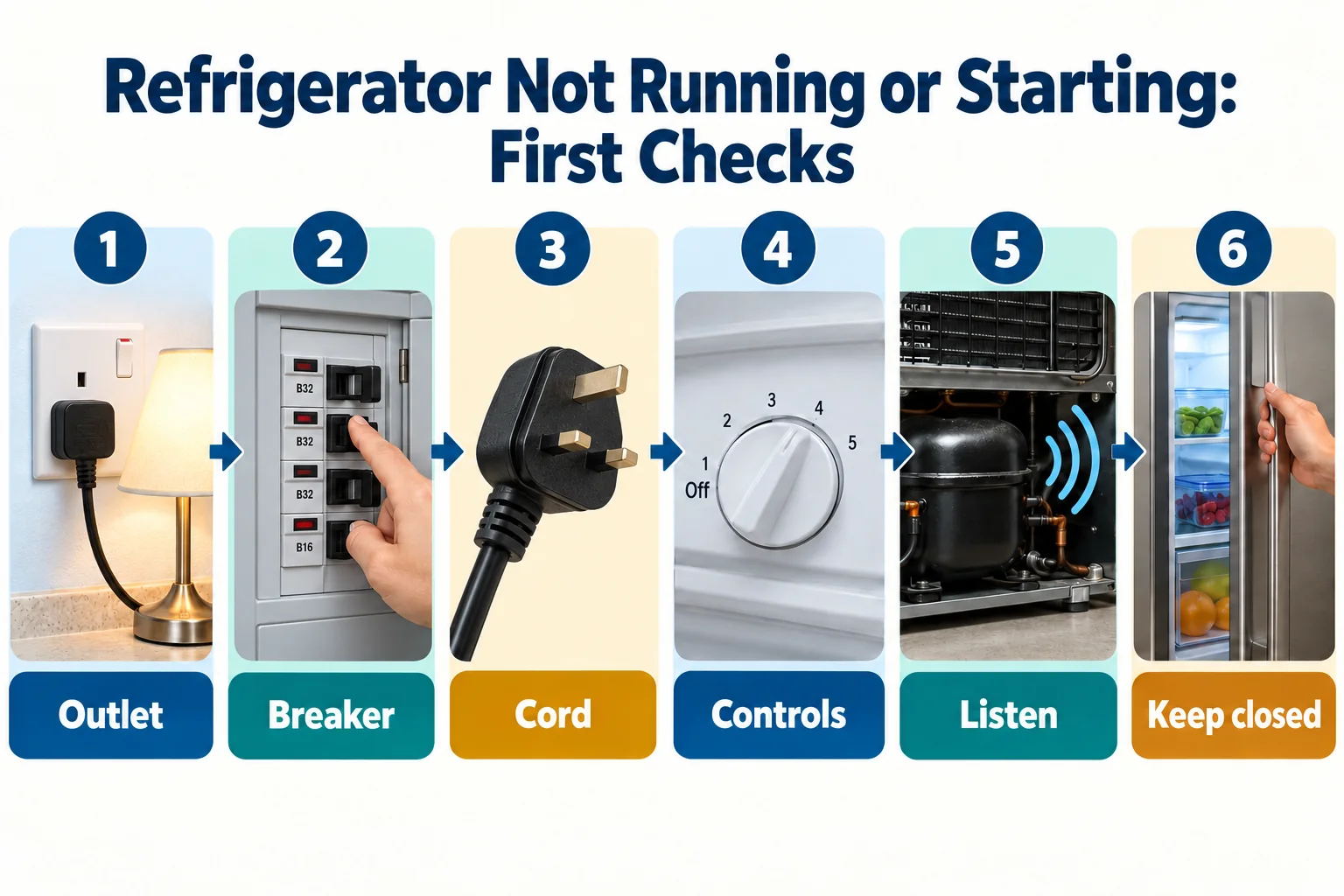
Six first checks resolve many no-power complaints before any part is replaced.
Safety notice: Unplug the refrigerator before touching any part behind a panel. Do not open outlets, panels or wiring. Electrical testing, refrigerant handling and sealed-system work belong to a technician or an electrician.
- Confirm that the plug sits fully in the outlet.
- Inspect the power cord for cuts, burns or crushed sections.
- Reset the circuit breaker if it has tripped.
- Press the test and reset buttons on any GFCI outlet.
- Turn off demo mode, and confirm that the control is not set to off.
- Check whether a recent power outage tripped the breaker or reset the settings.
Test the outlet with a lamp that works elsewhere. Brands name demo mode differently, and the manual explains the display and button sequence. Photograph the control panel and any code before changing anything. Call an electrician if the outlet has no power after the breaker is reset. Stop using the refrigerator if the cord is damaged, because a technician must replace the cord.
Is Anything Running?
The light, the fans and the compressor sound separate a power fault from a cooling fault. The table below matches five observations to their likely causes. Each cause is explained in the sections that follow.
| Observation | Likely cause |
|---|---|
| No light, no fans, no sound, blank display | Power fault or control board |
| Light and display on, no fans, no compressor | Demo mode, an off setting, control board or thermostat |
| Light on, fans running, compressor silent | Start relay, overload protector, thermostat or compressor |
| Compressor clicks every few minutes without starting | Start relay or compressor |
| Compressor hums, then stops | Overload protector or compressor |
A dark interior with otherwise normal operation points to the bulb or the door switch, covered in refrigerator light not working.
Is the Start Relay or the Overload Protector Failing?
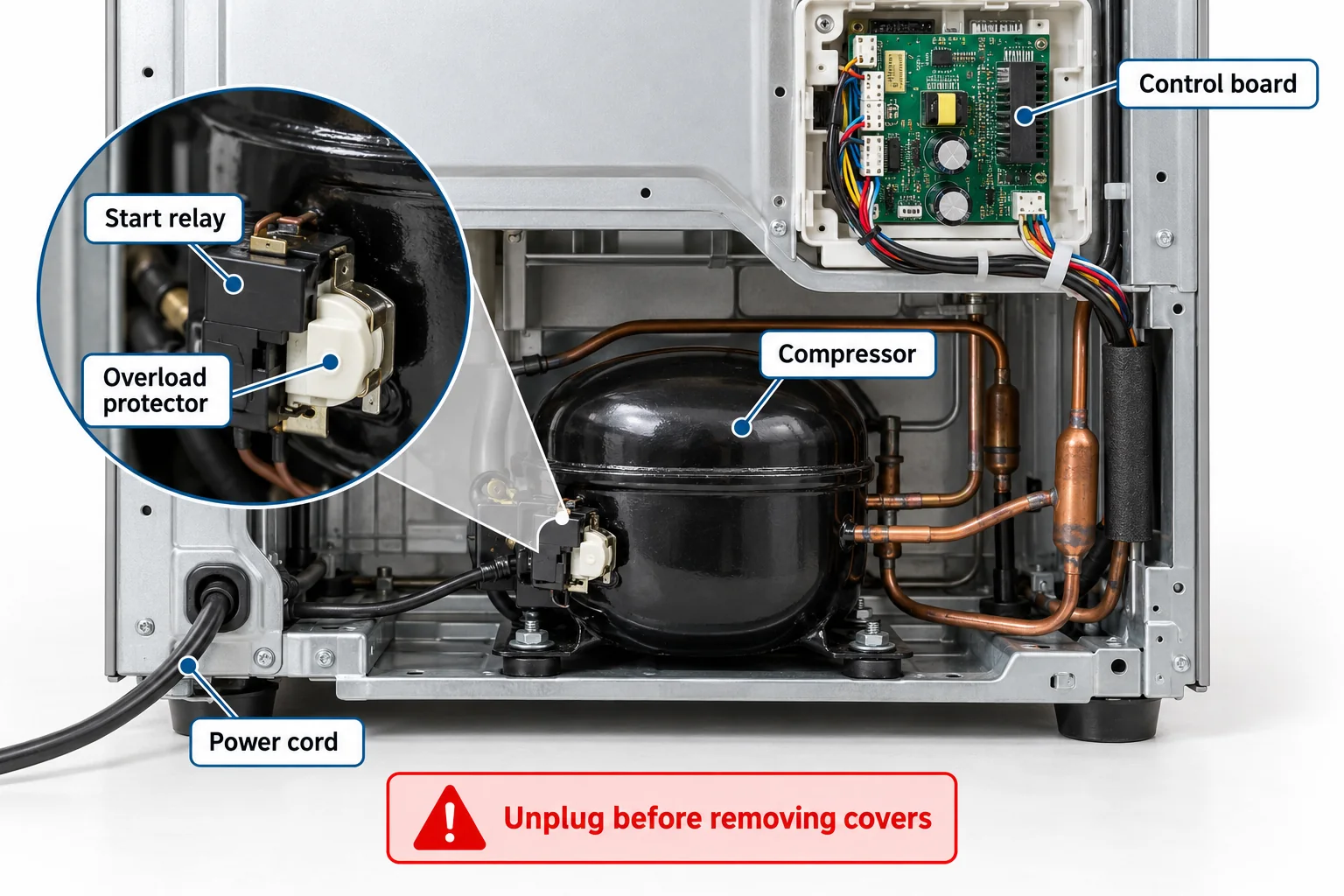
The start relay and the overload protector control how the compressor starts, so a fault in either one stops cooling. In many models the two parts sit together in one assembly on the side of the compressor.
Is the start relay failing?
A failed start relay prevents the compressor from starting, which produces repeated clicking and no cooling. Listen for a click every few minutes without the compressor running. A technician tests the relay with a meter. Replace the relay if it fails the test. Difficulty: moderate. Testing and replacement are in refrigerator start relay.
Is the overload protector tripping?
A tripping overload protector cuts power to the compressor when it overheats or draws too much current, which stops the compressor after a short hum. A unit that restarts and stops repeatedly points to an overheating compressor or a weak start relay. A technician checks the protector together with the relay. Difficulty: technician-assisted.
Is the Control Board or the Thermostat at Fault?
A failed control board or thermostat stops the cooling cycle from starting, even when power reaches the refrigerator. Rule out demo mode, the off setting and the power supply first.
Is the control board failing?
A failing control board stops power from reaching the compressor and fans, and the display or light can stay on. On electronic models, the board switches the compressor and the fans. A power reset clears some temporary faults. Replace the board only after a technician confirms the fault. Difficulty: technician-assisted. Signs and options are in refrigerator control board failure signs.
Is the thermostat faulty?
A faulty thermostat stops the cooling cycle from starting at any dial setting. Many older models use a mechanical dial thermostat that has an off position. A dial set to the warmest position can also leave the compressor off. A technician checks the thermostat with a meter and the manufacturer specification. Replace the thermostat if it fails the check. Difficulty: moderate.
Is the Compressor Failing?
A failed compressor does not start or stops immediately, and it needs a technician, because refrigerant handling requires EPA Section 608 certification. Rule out the supply, the relay, the overload protector and the board first. A compressor that hums, clicks or trips the overload protector without starting, after those parts pass, has probably failed. A seized compressor often hums and then trips the overload protector. A technician confirms the fault by testing the windings and the starting parts. Ask the technician for a written quote that separates parts and labor. Compressor replacement is a sealed-system repair, so the repair-or-replace decision starts here. Never vent refrigerant, add refrigerant or cut refrigerant lines. Difficulty: technician-only. The signs and testing limits are in refrigerator compressor problems.
Could the Power Supply or a Surge Be the Cause?
A weak supply, a faulty extension cord or a surge can stop a sound refrigerator. Plug the refrigerator directly into a grounded outlet, as most manuals advise, and avoid extension cords and adapters. A compressor draws more current at startup than while running, so a weak circuit can fail at startup, as explained in refrigerator running amps and power draw. A surge can damage the control board, so ask a technician about suitable protection. Call an electrician for outlet or wiring faults.
What Should You Do With the Food?
Keep the doors closed and move perishable food to a cooler with ice if the refrigerator stays off. A closed refrigerator keeps food cold for about 4 hours. Keep raw meat, poultry and fish apart from ready-to-eat food, and check food with a thermometer before use. The hold times and the discard rules are in how long food stays safe in a refrigerator without power.
When Should You Call a Technician?
Call a technician when the compressor does not start, when the overload protector keeps tripping or when the control board fails. Call an electrician when the outlet has no power after the breaker is reset. Stop using the refrigerator if the cord is damaged. Call a technician before replacing a part that cannot be tested, because a wrong part adds cost. Ask for a written quote that separates parts and labor.
What Do People Also Ask About a Refrigerator Not Running or Starting?
Why is my refrigerator not running but the light is on?
A lit interior with no cooling points to demo mode, an off setting, a failed control board or a compressor start fault.
Why does my refrigerator click but not start?
Repeated clicking points to a failed start relay or a compressor that cannot start.
Why did my refrigerator stop working after a power outage?
An outage can trip the breaker, reset the settings or expose a weak relay or board.
Related refrigerator guides
US and UK refrigerant-work boundary
Home diagnosis must stop before opening, cutting or tapping the sealed refrigerant circuit. In the US, EPA Section 608 certification is required for work that could release refrigerant. In the UK, work on equipment containing F-gas requires the relevant qualification. Refrigerant type and local rules vary, so use a qualified refrigeration technician for sealed-system work.
Hi, I’m Ryan, a refrigeration engineer based in the UK Midlands. I’m passionate about engineering, technology, and understanding how things work, especially when it comes to heating, ventilation, air conditioning, and refrigeration systems.
I enjoy the hands-on side of engineering, from working with technical equipment to exploring practical solutions to everyday challenges. For me, engineering is more than just a profession; it’s about problem-solving, continuous learning, and developing valuable technical skills.
I also enjoy sharing glimpses of the engineering world through my Instagram page, @hvac.razza, where I showcase tools, equipment, and aspects of HVAC work.
Outside the technical side of things, I value genuine connections, meaningful conversations, and opportunities to learn from others. I’m always interested in connecting with people who share an appreciation for technology, practical skills, and personal growth.