
Refrigerator Power Consumption: 6 Factors, 5 Measuring Steps and 4 Cost Steps
How Much Power Does a Refrigerator Use?
A refrigerator uses power in cycles, so its use depends on the model, the load, the room and how long the compressor runs. The compressor starts and stops as the cooling cycle in refrigerator cooling cycle explains, so the power use rises and falls through the day. This page gives no amps, watts or costs from memory, because the label, the manual and your own bill set them.
Record the running amps, rated watts and annual energy figure only from the exact model’s rating label, energy label or manufacturer document. Do not copy a typical figure from another refrigerator, because the ratings vary by model and configuration.
Why does the power use change through the day?
The compressor cycles on and off, and the fans, the lights and the defrost parts add to the load at times. A warm load, an open door or a hot room lengthens the running time.
What Do Amps, Watts and Energy Cost Mean?
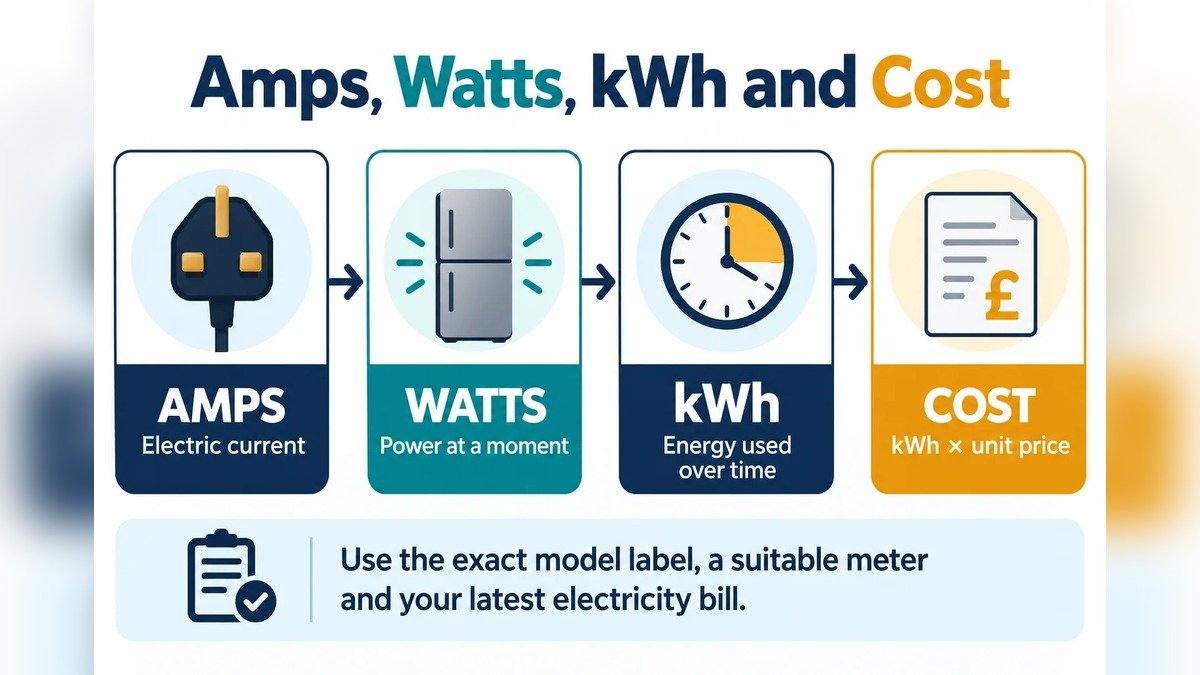
Amps measure the electric current, watts measure the power and the energy cost follows the energy used over time. Watts equal volts times amps, so a label that states two of them gives the third. Use the supply and appliance ratings printed on the exact model’s label or manual; do not assume a voltage or current rating from another appliance. The label shows what the refrigerator is rated to draw, and the energy used over a period shows on the bill.
Is the label rating the same as the real use?
No. The label gives a rated value, and the real use depends on how long the compressor runs in your kitchen. Measure the real use as the measuring section shows.
What Raises a Refrigerator’s Power Use?
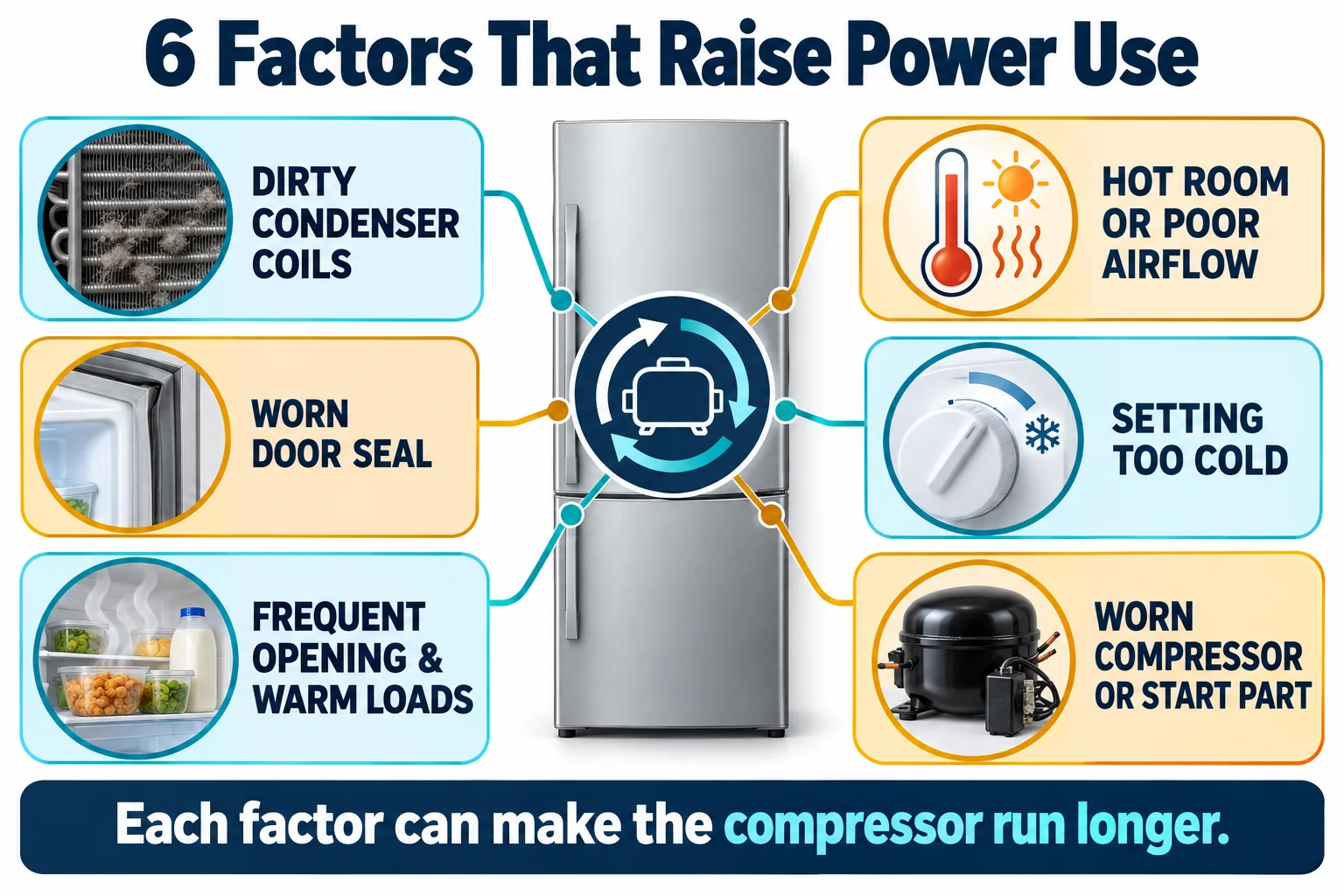
Six factors raise the power use, and each one makes the compressor run longer.
- Dirty or blocked condenser coils
- A worn door seal that leaks warm air
- Frequent door opening and warm loads
- A hot room or a tight space with no airflow
- A setting that is colder than needed
- A worn compressor or a failing start part
A refrigerator that runs more than it used to, with no change in the load, points to one of these, and the checks start with the seal, the coils and the airflow.
Does an older refrigerator use more power?
It can, because seals and parts wear, but a measurement of your own refrigerator settles it.
How Do You Measure a Refrigerator’s Real Power Use?
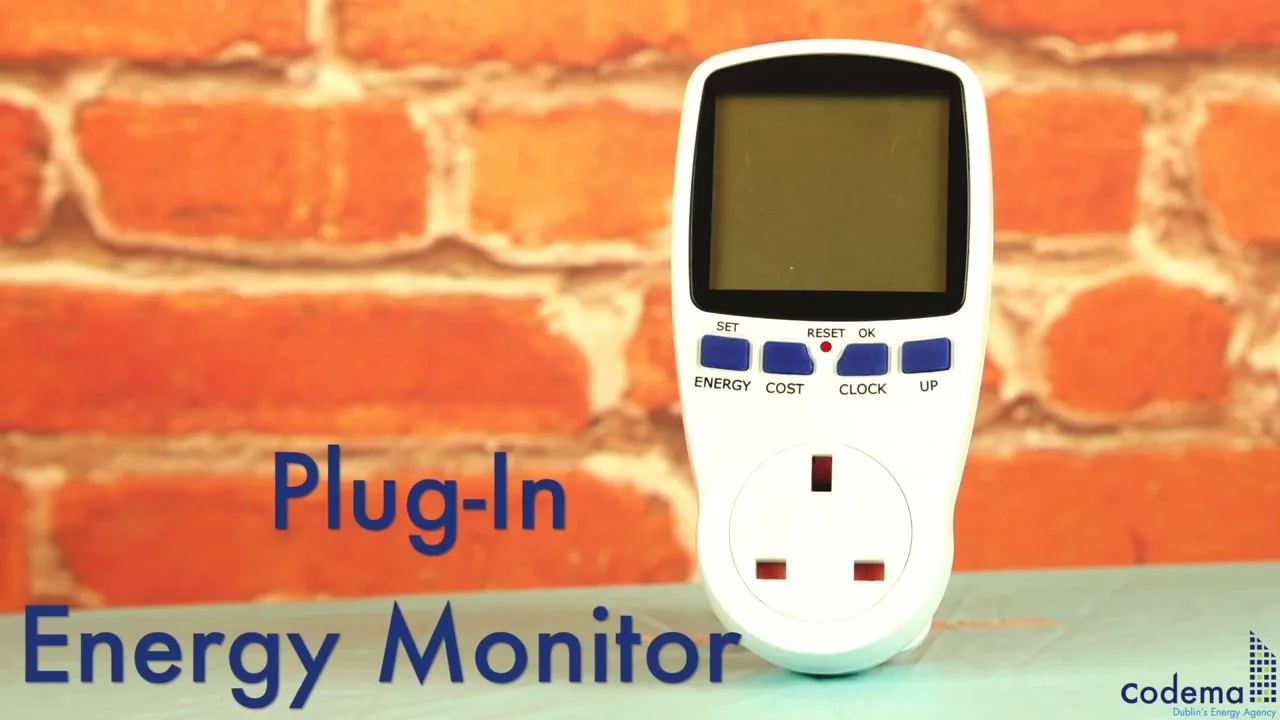
Plug the refrigerator into a plug-in energy meter that covers its label rating, and read the meter over a normal period of use.
Safety notice: Unplug the refrigerator before you fit the meter, use only a meter whose rating covers the label of the refrigerator, and do not use an extension cord or a damaged or wet outlet or cord. Electrical testing, refrigerant handling and sealed-system work belong to a technician.
Five steps measure the use:
- Read the electrical rating on the label, and check that the meter covers it.
- Unplug the refrigerator, plug the meter into the outlet and plug the refrigerator into the meter.
- Clear the meter’s reading as its manual shows, and note the time.
- Leave the refrigerator running through normal use, with the doors opened as usual.
- Read the energy used after the period that the meter manual advises, and record the reading, the time and the room.
Difficulty: easy.
How long should you measure for?
Measure over a long enough period to include several compressor cycles and normal door use, as the meter manual advises.
How Do You Work Out the Running Cost?
Multiply the energy that the refrigerator uses by the current unit price on your electricity bill. Tariffs vary by supplier, plan, region and date, so use the unit rate from the household’s latest bill rather than a national estimate. Four steps give the cost:
- Take the energy used from your meter reading or from the rated annual use on the label.
- Find the price per unit of energy on your latest electricity bill.
- Multiply the energy used by the price per unit, and note the period that the energy covers.
- Record the result with the date, because prices and readings change.
Difficulty: easy.
Does the running cost justify a replacement?
A sudden rise in the cost points to a fault, so find the fault before you compare the cost of a replacement.
Why Does the Compressor Matter for Power Use?
On most refrigerators the compressor is the largest electric load, so a compressor that struggles or runs long raises the power use. The signs of a failing compressor are in refrigerator compressor. A compressor can draw more current when it starts than when it runs, and the start relay helps it start, as refrigerator start relay explains.
What size circuit or generator does a refrigerator need?
The manual and the label state the electrical needs, and a qualified electrician must size any circuit or generator. Do not run a refrigerator from a cord or a generator that the label does not cover.
How Can You Reduce a Refrigerator’s Power Use?
Fix the factors that make the compressor run longer: the seal, the airflow, the load, the setting and the room. Give the refrigerator the space for airflow that the manual states, and keep the doors closed as much as you can. Let warm food cool before you store it, and set the temperature as the manual advises. A seal that leaks or coils that are blocked need attention, and the manual or a technician can advise on the repair.
Does unplugging the refrigerator overnight save money?
No. The food warms while the refrigerator is off, so keep it running and fix the factors instead.
When Should You Call a Technician?
Call a technician when the power use rises with no change in the load, the compressor is loud, hot or clicking, or the breaker trips. A fan that does not turn, an oily residue and any sealed-system fault need a technician. Stop and unplug the refrigerator if you smell burning. Give the technician the model number, the meter readings with the dates and what you checked. Under warranty, call the manufacturer first, because the warranty terms decide who may repair it. Otherwise, ask for a written quote that names the fault.
What Do People Also Ask About Refrigerator Power Consumption?
How many watts does a refrigerator use?
The label and the manual state the rated watts for the model, and the sourced figures are in the first section.
How much does it cost to run a refrigerator?
Multiply the energy used by the price per unit on your bill, as the four cost steps show.
Does a refrigerator use more power when it starts?
It can draw more current at startup, and the start relay helps the compressor start, as explained in refrigerator start relay.
Does a failing compressor raise the power use?
It can, because the compressor runs longer or struggles to start, as explained in refrigerator compressor.
How does a refrigerator use energy to keep food cold?
A compressor, coils and fans move heat out of the cabinet, as explained in refrigerator cooling cycle.
US and UK power-use context
The calculation is the same in both markets: energy used in kilowatt-hours (kWh) multiplied by your electricity rate. Use cents per kWh for a US bill or pence per kWh for a UK bill. Read voltage, current and frequency from the refrigerator nameplate; do not assume US 120 V or UK 230 V values apply to every model.
Starting current can be much higher than running current. Do not size wiring, fuses, breakers, extension leads or generators from a web estimate; use the appliance manual, nameplate and a qualified electrician.

Hi, I’m Ryan, a refrigeration engineer based in the UK Midlands. I’m passionate about engineering, technology, and understanding how things work, especially when it comes to heating, ventilation, air conditioning, and refrigeration systems.
I enjoy the hands-on side of engineering, from working with technical equipment to exploring practical solutions to everyday challenges. For me, engineering is more than just a profession; it’s about problem-solving, continuous learning, and developing valuable technical skills.
I also enjoy sharing glimpses of the engineering world through my Instagram page, @hvac.razza, where I showcase tools, equipment, and aspects of HVAC work.
Outside the technical side of things, I value genuine connections, meaningful conversations, and opportunities to learn from others. I’m always interested in connecting with people who share an appreciation for technology, practical skills, and personal growth.