

Repair or Replace a Refrigerator: 5 Replacement Signs, 4 Deciding Questions and 4 Next Steps
Should You Repair or Replace a Refrigerator?
Repair a refrigerator when the fault is minor and the unit is young, and replace it when the quote is high for its remaining life. Four things decide the verdict: the age of the unit against its expected life, the repair quote against the price of a comparable new unit, the repair history and the running cost. The expected life of a refrigerator is covered in refrigerator lifespan. This site sells no parts and no refrigerators, so the verdict follows the facts and not a sale.
What Are the Signs It Is Time to Replace a Refrigerator?
Five signs point to replacement instead of repair.
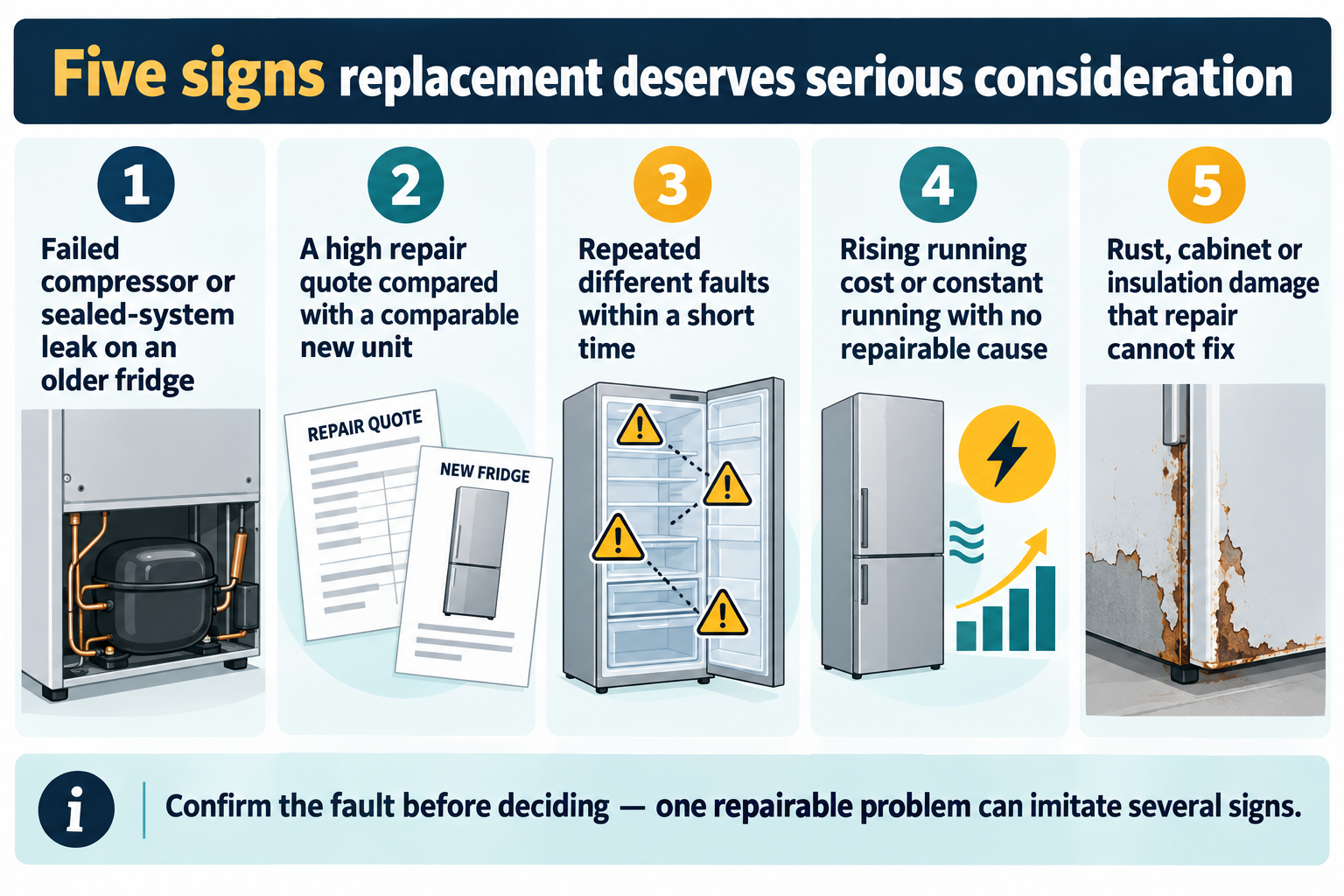
- A failed compressor or a sealed-system leak in an older refrigerator
- A repair quote that is high compared with a comparable new unit
- Repeated repairs for different faults within a short time
- Rising running cost, or constant running with no repairable cause
- Rust, cabinet damage or insulation damage that a repair cannot fix
Several of these signs also come from a single fault that a repair fixes, so confirm the fault before you decide.
Is a failed compressor a reason to replace?
On an older refrigerator, yes, because a compressor repair usually costs a large share of a new unit. On a young refrigerator, the quote and any warranty decide.
Does a refrigerator that keeps breaking need replacing?
Yes, when several different parts fail within a short time, because further failures are more likely and each repair adds to the cost. One repair after years of service does not point to replacement.
Which Questions Decide the Verdict?
Four questions decide the verdict.
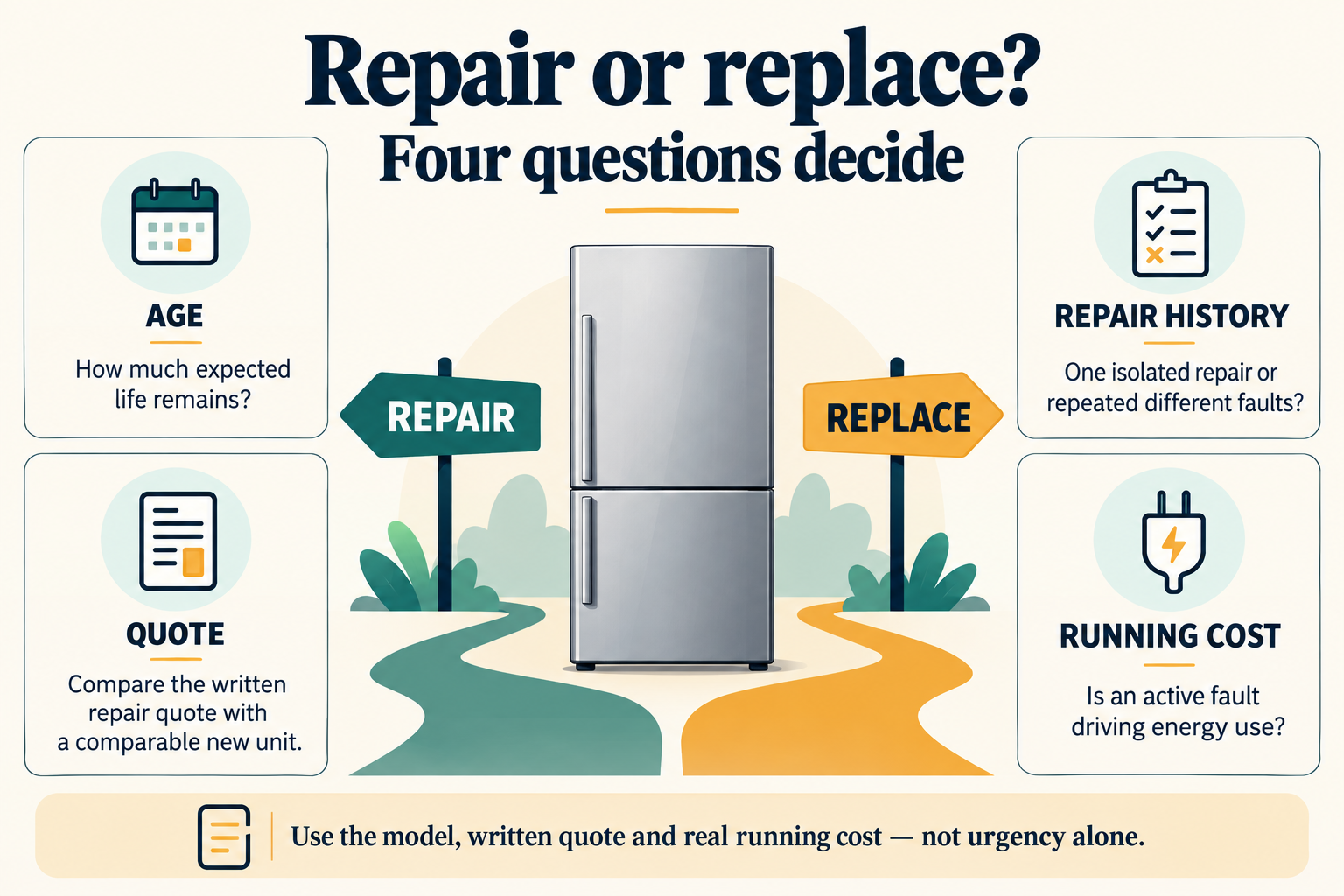
- How old is the refrigerator compared with its expected life?
- How does the written repair quote compare with the price of a comparable new refrigerator?
- How many repairs has the refrigerator needed, and how recently?
- What does the refrigerator cost to run compared with a new one?
Answer each question with the quote and the age in hand. A young refrigerator with a small quote is a repair, and an old refrigerator with a large quote is a replacement. The cases in between depend on the repair history and the running cost.
How Does Age Change the Verdict?
Age is the first test, because a younger refrigerator has more remaining life to repay a repair. A refrigerator near the end of its expected life gains little from a costly repair, and the warning signs of the end of life are listed in refrigerator lifespan. Find the age from the purchase record or from the manufacturer documentation for the serial number.
How Does Price Pressure Change the Verdict?
Compare the written repair quote with the price of a comparable new refrigerator, including delivery and removal of the old unit. A sale price can make a new refrigerator look cheaper than it is, so compare units of the same size, type and features. Removal and recycling of the old unit add to the replacement cost, as explained in dispose of an old refrigerator. Do not decide on the day of the breakdown without the written quote, because urgency pushes people toward the first offer.
What should the written quote show?
A written quote should list the fault, the parts, the labor and the diagnostic fee as separate lines. Ask whether a warranty still covers the repair or the part, and how long the quote stays valid.
How Does Running Cost Change the Verdict?
An older refrigerator often costs more to run than a new one, so add the running cost to the comparison. The difference matters most when the repair quote is close to the price of a new unit. Compare the energy label or the rated power of both refrigerators, as explained in refrigerator energy use and running cost. A refrigerator that runs constantly may use extra power because of a fault, and the repair can bring the cost back down.
Which Repairs Are Usually Worth Making?
Repairs to the door seal, fans, start relay, defrost heater and sensors are usually worth making when the refrigerator has life left. These parts usually cost much less than the refrigerator. A control board on a younger refrigerator can also be worth the repair, as a technician confirms. A failed compressor or a sealed-system leak shifts the verdict toward replacement on an older unit, and sealed-system work belongs to a technician.
Does a control board fault justify a new refrigerator?
Not on a younger refrigerator, because a control board repair usually costs less than a new unit once a technician confirms the fault. On an older refrigerator, weigh the quote against the remaining life.
What Should You Do After the Verdict?
After a repair verdict, approve the written quote, and after a replace verdict, plan the removal of the old unit.
Safety notice: Do not cut, puncture or open the cooling lines of an old refrigerator, because refrigerant handling and sealed-system work belong to a technician. Unplug the refrigerator before you move it.
Four steps follow a decision to replace:
- Compare comparable new refrigerators by size, type and running cost, and not by price alone.
- Keep the old refrigerator running until the new one is ready to install, and move the food only at the swap.
- Plan the removal and the recycling of the old refrigerator, as explained in dispose of an old refrigerator.
- Leave the cooling lines of the old refrigerator intact for the recycler.
Record the model number and the age of the old refrigerator before it leaves, because the retailer or the recycler may ask for them. Keep the repair quote, because it shows the basis of the verdict.
What Do People Also Ask About Repairing or Replacing a Refrigerator?
When should you replace a refrigerator instead of repairing it?
Replace it when the repair quote is high for the life that remains, or when several parts fail within a short time.
Is it worth repairing an old refrigerator?
A repair on an old refrigerator is worth making when the fault is minor and the quote is small, but not after a compressor failure.
How long should a refrigerator last?
Expected life depends on the model and the use, as explained in refrigerator lifespan.
What happens to the old refrigerator after a replacement?
Removal is arranged with the retailer or a recycler, as explained in dispose of an old refrigerator.
Do old refrigerators cost more to run?
An older refrigerator often uses more power than a new one, as explained in refrigerator energy use and running cost.