
Refrigerator Parts and Cooling Cycle: 5 Cooling Parts, 4 Cycle Stages and 5 Supporting Parts
How Does a Refrigerator Work?
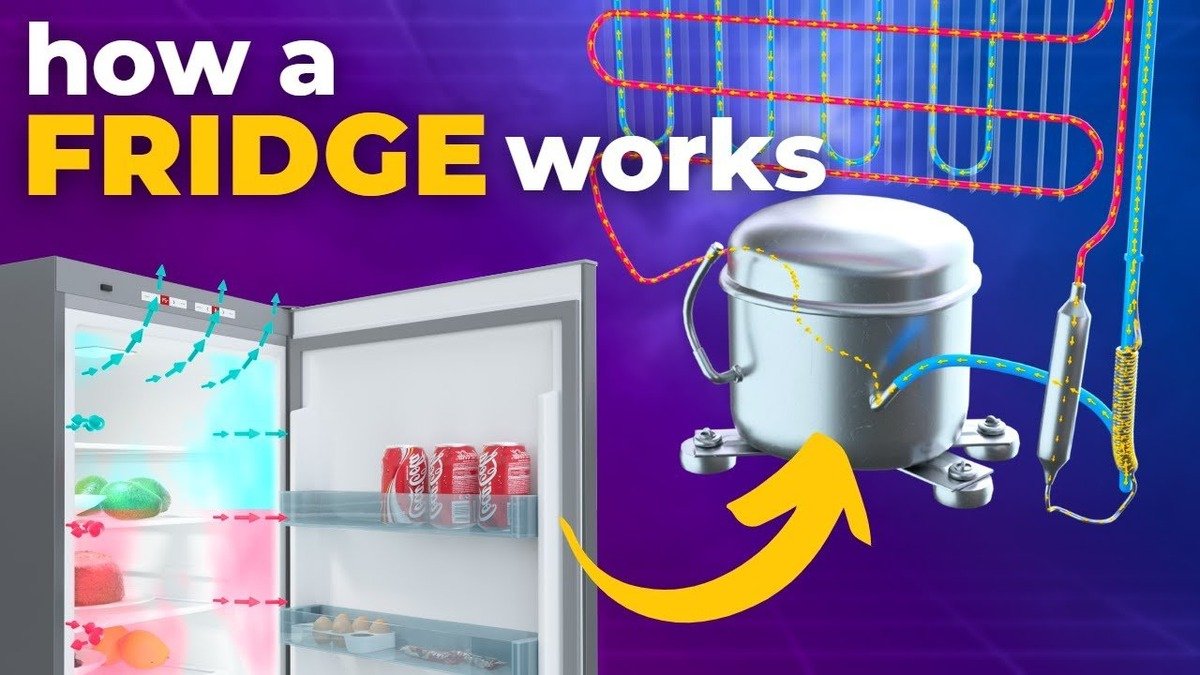
A refrigerator moves heat out of the cabinet with a sealed refrigerant circuit, and fans, sensors and a control board manage the cycle. The refrigerant absorbs heat from the food compartments, carries it to the condenser and releases it into the room air. Insulation in the walls and the door seals keep the outside heat from returning. This page is the definition page for the site, and each fault and part has its own page that builds on it.
Does a refrigerator make cold?
No. A refrigerator removes heat, and the cold is what remains when the heat leaves. The compartments cool because the circuit keeps pulling heat out of them.
What Are the Main Parts of the Cooling System?
Five parts form the sealed cooling circuit.
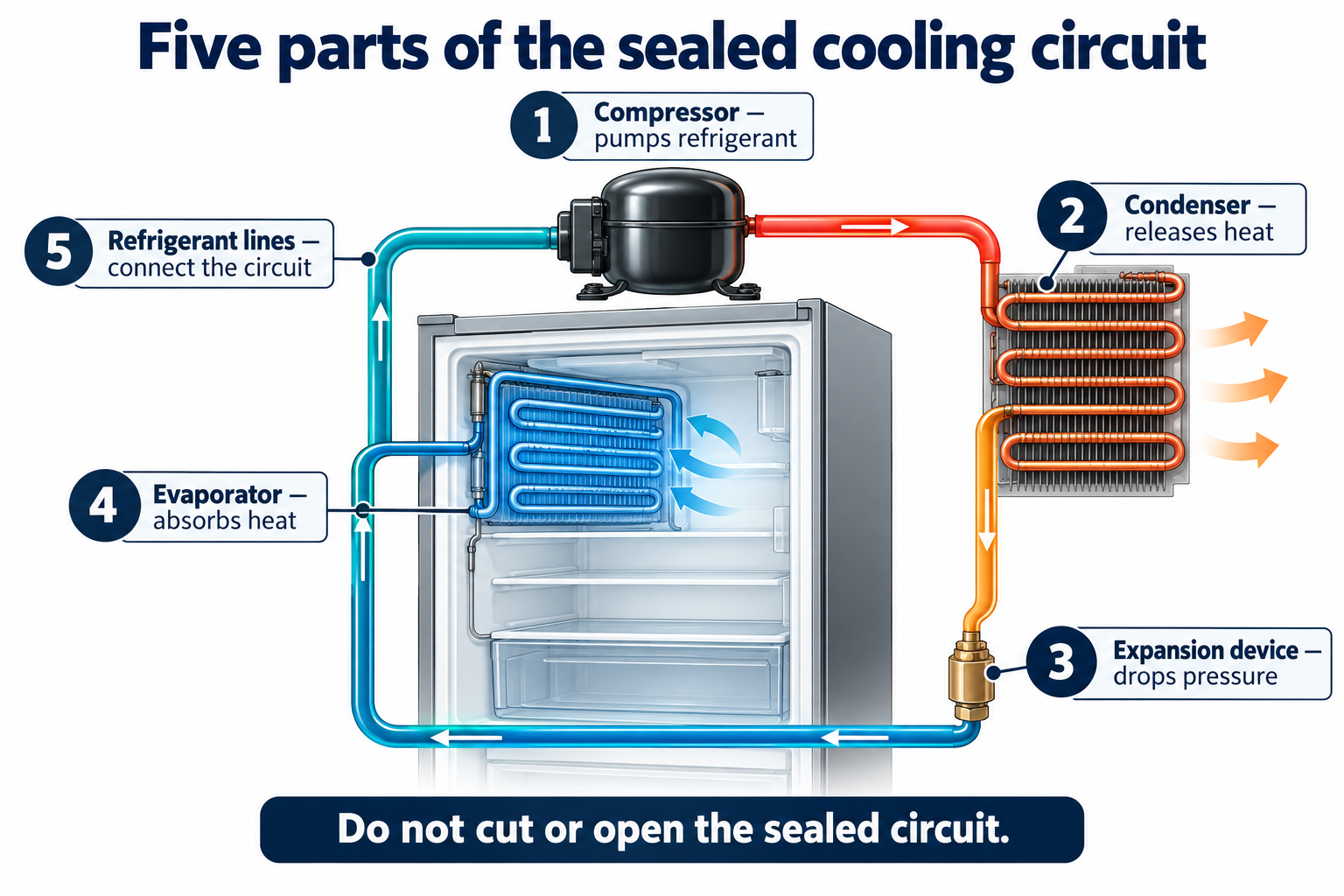
Safety notice: Do not open, cut or puncture the sealed cooling circuit, because refrigerant handling belongs to a technician. Unplug the refrigerator before touching any part behind a panel.
- The compressor, which pumps the refrigerant around the circuit
- The condenser coil, which releases heat to the room air
- The expansion device, which drops the refrigerant pressure
- The evaporator coil, which absorbs heat from the compartments
- The refrigerant lines, which connect the parts into one sealed circuit
The circuit is sealed and holds refrigerant, so a leak or a blockage in it is a technician’s job.
What does the compressor do?
The compressor pumps the refrigerant and raises its pressure and temperature, and the control board switches it on and off. It is the part that makes the cycle run.
Where are the coils?
On many models the evaporator sits behind a panel inside and the condenser sits at the back or the bottom. The manual for the model shows the position of both coils.
What Are the Four Stages of the Cooling Cycle?
Four stages repeat for as long as the refrigerator cools. The stages follow the path of the refrigerant:
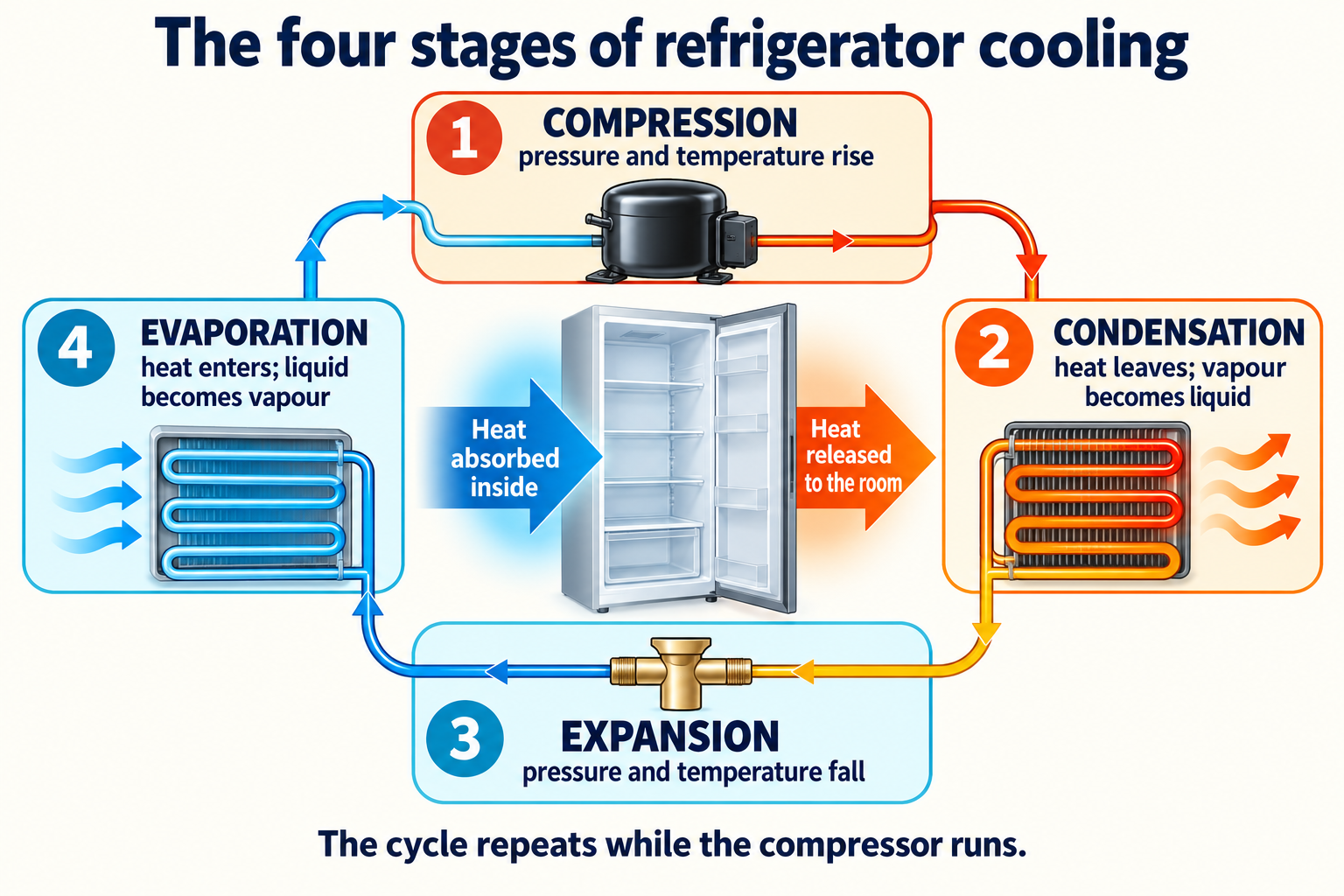
- Compression: the compressor squeezes the refrigerant vapor, which raises its pressure and temperature.
- Condensation: the hot vapor releases heat to the room air in the condenser coil and turns into a liquid.
- Expansion: the liquid passes through the expansion device, where its pressure and temperature drop.
- Evaporation: the cold refrigerant absorbs heat in the evaporator coil and turns back into vapor, which returns to the compressor.
The cycle runs in bursts, because the control board switches the compressor on when the compartment warms and off when it reaches the set temperature.
What Controls the Cooling Cycle?
The control board or thermostat, the temperature sensors and the door switch control the cooling cycle. The sensors report the compartment temperatures, and the board switches the compressor, the fans and the defrost heater to match the setting. Mechanical models use a dial thermostat and a timer instead of a board. The setting you choose is the target, and the settings are covered in refrigerator temperature settings.
How does the thermostat decide when to cool?
It compares the compartment temperature with the setting and switches the compressor on when the compartment is warmer. A compressor that runs constantly points to a fault or a heavy load.
What Are the Supporting Parts of a Refrigerator?
Five supporting parts help the cooling circuit do its work.
- The evaporator and condenser fans, which move air across the coils and through the compartments
- The temperature sensors, the thermostat and the control board, which manage the cycle
- The defrost system, which melts frost from the evaporator and drains the water
- The door seal, which keeps warm air out
- The light and the door switch, and on some models the water inlet valve and the ice maker
A fault in any of these parts can stop the cooling even when the sealed circuit is sound.
What does the defrost system do?
The defrost system warms the evaporator coil at intervals to melt frost, and the meltwater drains to a pan where it evaporates. A blocked drain or a failed heater disturbs this cycle.
How Much Power Does a Refrigerator Use?
A refrigerator uses power mainly when the compressor and the fans run, so the running time sets the use. Frequent door opening, a dirty condenser coil, a worn door seal and a warm room lengthen the running time. The amps, the watts and the running cost are explained in refrigerator power consumption.
Why does a refrigerator draw more current at startup?
The compressor usually draws more current for a moment when it starts than while it runs. The rating for the model comes from the manual, and a compressor that struggles to start points to a fault in the start parts.
Why Do the Size and Weight of a Refrigerator Matter?
Size, capacity and weight decide where a refrigerator fits and how it is moved, and the dimensions come from the manual for the model. Most models also need clearance for airflow around the unit, and the manual states the clearance. The details are explained in refrigerator size and weight.
Where do you find the dimensions and the weight?
The manual for the model number lists the dimensions and the weight, and the manufacturer support page carries the same document. Measure the doorway and the path before you move the unit.
What Happens When a Refrigerator Starts Up?
A new or moved refrigerator needs time to cool before it holds its set temperature, and the manual states the time for the model. After a move, the manual may require the unit to stand upright before it is plugged in, because the compressor oil needs to settle. The cooling time and the settling steps are explained in refrigerator startup.
Should you plug in a new refrigerator right away?
Follow the manual, which states whether the unit must stand for a time before it is plugged in. Keep the doors closed during the first cool-down, and load the food after the compartments reach the set temperature.
What Do People Also Ask About How a Refrigerator Works?
How does a refrigerator work?
A sealed refrigerant circuit absorbs heat inside the cabinet and releases it into the room, and fans and a control board manage it.
What are the main parts of a refrigerator?
The main parts are the compressor, the condenser, the expansion device, the evaporator, the fans, the control board and the door seal.
Does a refrigerator need its refrigerant topped up?
No. The refrigerant circuit is sealed, so low refrigerant means a leak that a technician must find and repair.
Why does a refrigerator turn on and off?
The control board switches the compressor on when the compartment warms and off when it reaches the set temperature.
What temperature should a refrigerator be set to?
Set the temperature as the manual states, and the ideal settings are explained in refrigerator temperature settings.