
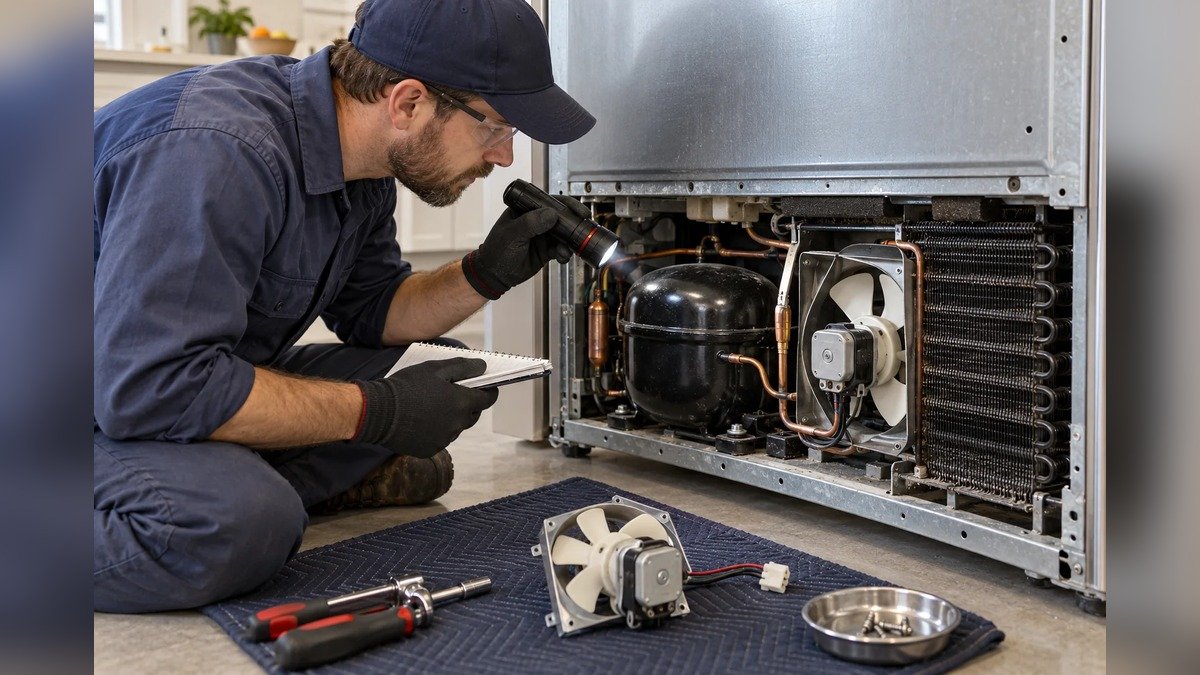
Refrigerator Fan Motors: 5 Failure Signs, 4 Rule-Outs and 6 Checks
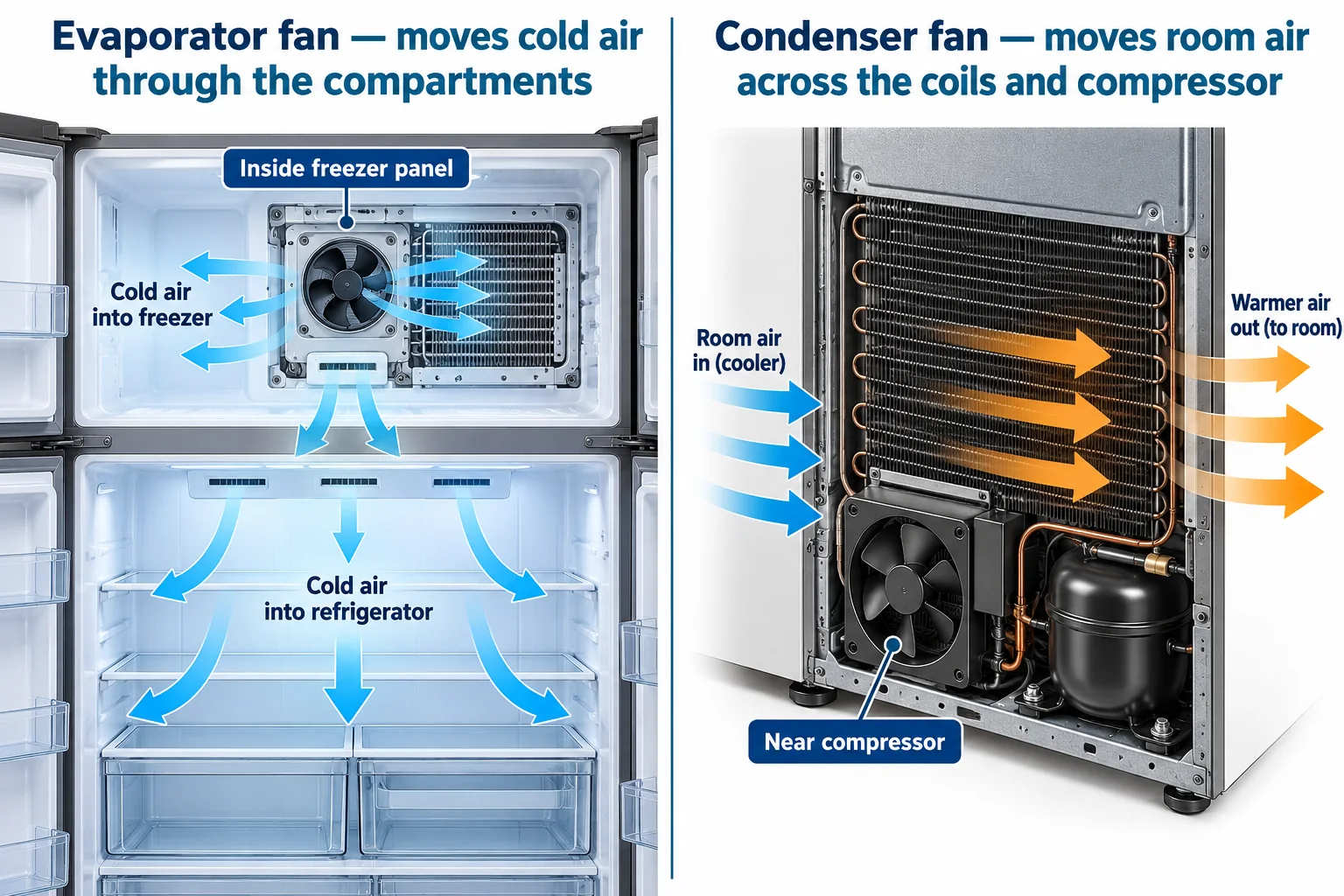
What Do the Refrigerator Fan Motors Do?
The evaporator fan moves cold air through the compartments, and the condenser fan moves room air across the condenser coils and the compressor. The evaporator fan sits behind a panel in the freezer, and the condenser fan sits near the compressor at the bottom or back. A fan that slows or stops leaves one compartment cold and another warm, or makes the compressor run hot. A failing fan often makes a sound first, and the other sounds are in refrigerator noises.
What Are the Signs of a Failed Fan Motor?
Five signs point to a failed fan motor.
- The freezer is cold, but the refrigerator compartment is warm
- A buzz, rattle, squeal or grind comes from the back of the freezer or from the compressor area
- No air flows from the vents inside the compartments
- Frost builds on the back wall of the freezer
- The compressor area is hot and the refrigerator runs constantly
Signs one, three and four point to the evaporator fan, and sign five points to the condenser fan. Sign two can come from either fan. All five signs also come from other faults, so rule those out first.
Can one fan fail while the other keeps working?
Yes. Each fan has its own motor, so one can fail while the other runs. The signs show which fan to check first.
What Else Looks Like a Failed Fan Motor?
Four other faults mimic a failed fan, so rule them out before you buy a part.
- Food or packaging blocking the vents or the air path inside the compartments
- Ice or frost on the fan blades or in the air duct
- Dirty condenser coils or blocked airflow at the back of the unit
- A loose item, a tray or an unlevel cabinet that rattles
Clear the vents first and check the level of the cabinet. Dirty coils give a hot compressor area and long running, and the cleaning steps are in refrigerator condenser coil cleaning. Ice on the fan points to a defrost fault, so a technician should confirm the cause.
Where Are the Fan Motors?
On many models the evaporator fan sits behind a freezer panel, and the condenser fan sits near the compressor. The manual for the model shows both positions and the panels to remove. Record the model number before you search for the manual.
What if you cannot find a fan?
Some compact and older models have no fan or only one, and the manual says which fans the model has. Do not remove any panel beyond the ones that the manual shows.

How Do You Check a Fan Motor?
Listen for each fan, feel for airflow and look for blockages before you decide that a motor has failed.
Safety notice: Unplug the refrigerator before touching any part behind a panel. Keep fingers, hair and cloth away from a fan that is running. Electrical testing, refrigerant handling and sealed-system work belong to a technician.
Six checks cover the fans:
- Clear the vents and move food away from the air path in the freezer and the refrigerator compartment.
- Listen at the back of the freezer while the compressor runs, and note whether a whir, a rattle or silence comes from the evaporator fan.
- Feel for air at the vents inside the compartments, and compare the airflow with how it felt before.
- Listen near the compressor for the condenser fan, without removing a panel, and note any rattle, squeal or silence.
- Unplug the refrigerator, remove the panel that the manual shows, look for ice, dust or an item on the blades and turn them by hand to feel for grinding.
- Refit the panel, plug in the refrigerator and watch the airflow and the temperatures over the following hours.
Photograph the screws, the clips and the wiring before you remove anything. Do not pull on the wires, and do not run the refrigerator with the panel off. Difficulty: easy for the listening and airflow checks, moderate when a panel must come off, and technician-assisted when a motor must be tested or replaced.
Can You Replace a Fan Motor Yourself?
Replacement is technician-assisted, because a technician must confirm the fault and the new motor must match the model. A motor that spins freely by hand can still have a failed winding, and only an electrical test shows it. Do not buy a part until the fault is confirmed, because a motor fitted for the wrong fault fixes nothing.
How do you find the right replacement motor?
Use the model number, the manual and the manufacturer parts list, because a motor for another model can differ in size and fit. Do not rely on a part number from memory or from a different model.
What Happens If a Failed Fan Is Ignored?
A failed evaporator fan lets food warm and frost build, and a failed condenser fan makes the compressor run hot and long. Food spoils when the air stops moving, and frost can block the air path. A compressor that runs hot and long wears faster, which turns a small repair into a large one.
Can you run a refrigerator with a bad fan motor?
Only for a short time, because the food warms and the compressor strains, so arrange the repair promptly. Keep the doors closed, and read an appliance thermometer in each compartment.
When Should You Call a Technician?
Call a technician when a fan does not turn, a noise continues after the free checks, or you see damage or burn marks. If the checks find nothing, the other causes of weak cooling are in refrigerator not cooling. A noise that continues may come from another part, and the sounds are in refrigerator noises. A motor that must be tested, a seized or burnt motor and a fan with damaged wiring need a technician. Stop and unplug the refrigerator if you smell burning. Give the technician the symptoms, the sounds, what you checked and the model number.
What Do People Also Ask About Refrigerator Fan Motors?
Why is my refrigerator fan not working?
A fan stops when the motor fails, ice or an item jams the blades, or the power to the fan fails, so check blockages first.
How do I know if the evaporator fan motor is bad?
A warm refrigerator with a cold freezer, no airflow at the vents and no whir from the freezer back point to the evaporator fan.
What happens when the condenser fan fails?
The compressor area gets hot, the refrigerator runs constantly and the compartments warm, because the coils cannot shed their heat. Dirty coils give the same signs, and the cleaning steps are in refrigerator condenser coil cleaning.
Can you run a refrigerator with a bad fan motor?
Only for a short time, because the food warms and the compressor strains, so keep the doors closed and arrange a repair.
Why is my freezer cold but my refrigerator warm?
On many models a stopped evaporator fan keeps the cold air in the freezer, and the other causes are in refrigerator not cooling.

Hi, I’m Ryan, a refrigeration engineer based in the UK Midlands. I’m passionate about engineering, technology, and understanding how things work, especially when it comes to heating, ventilation, air conditioning, and refrigeration systems.
I enjoy the hands-on side of engineering, from working with technical equipment to exploring practical solutions to everyday challenges. For me, engineering is more than just a profession; it’s about problem-solving, continuous learning, and developing valuable technical skills.
I also enjoy sharing glimpses of the engineering world through my Instagram page, @hvac.razza, where I showcase tools, equipment, and aspects of HVAC work.
Outside the technical side of things, I value genuine connections, meaningful conversations, and opportunities to learn from others. I’m always interested in connecting with people who share an appreciation for technology, practical skills, and personal growth.