

Refrigerator Repair, DIY or Professional: 5 DIY Jobs, 5 Technician Jobs and 4 Safety Steps
Should You Repair a Refrigerator Yourself?
Do the repairs that need no live electrical test and no refrigerant, and leave sealed-system work and electrical diagnosis to a technician. A DIY repair suits a short list of jobs on a refrigerator that is unplugged and has its manual to hand. A repair outside that list risks an electric shock, a refrigerant release or a worse fault than the one you started with. The lists below name the jobs on each side, and the later sections cover the tools, the safety steps and the manuals.
Which Refrigerator Repairs Can You Do Yourself?
Five jobs suit a careful DIY repairer.
- Resetting the refrigerator with a power cycle
- Cleaning the condenser coils
- Replacing an interior light bulb
- Clearing a clogged defrost drain
- Replacing a worn door seal
Each job needs the refrigerator unplugged, the manual for the model and no refrigerant or live electrical test.
Is replacing a door seal a DIY job?
Yes, when the new seal matches the model, the refrigerator is unplugged and you accept a moderate job. Check the fit of the seal and the alignment of the door afterward, because a gap lets warm air in.
What do the difficulty labels mean?
Easy needs no panel removal, moderate needs a panel removed with basic tools, and technician-assisted needs a technician to confirm the fault. A power reset is easy, clearing a defrost drain is moderate and replacing a control board is technician-assisted.
Which Repairs Belong to a Technician?
Five jobs belong to a technician, because each carries a risk that tools and a manual do not remove.

- Sealed-system work, including leak repair and recharging
- Refrigerant handling and recovery
- Compressor replacement, as explained in refrigerator compressor problems
- Live electrical testing with the power on
- Control board diagnosis and replacement
This page gives no steps for these jobs. Refrigerant handling is certified work, and a sealed system that is opened or punctured cannot be repaired at home.
Why must a technician handle the sealed system?
The sealed system holds refrigerant, and opening it releases refrigerant and needs certified tools and training. A leak or a puncture can also leave the cooling system beyond repair, which shifts the verdict toward replacement.
What Tools and Safety Gear Does a DIY Repair Need?
Basic hand tools, a flashlight, a soft brush, towels and an appliance thermometer cover the DIY jobs listed here. Add a nylon brush for the drain and the coils, a cooler for the food and a camera to photograph the screws and the connectors. Wear gloves for sharp panel edges, and keep the floor clear and dry because meltwater makes it slippery. Do not use a pick, a knife or a screwdriver to chip ice, and do not use a heat gun or an open flame near the evaporator coil.
Do you need a multimeter for a refrigerator repair?
No multimeter is needed for the jobs listed here, and live electrical testing belongs to a technician.
What Safety Steps Come Before Any Repair?
Unplug the refrigerator, read the manual, photograph the work and stop at the first sign of damage.
Safety notice: Unplug the refrigerator before touching any part behind a panel. Electrical testing, refrigerant handling and sealed-system work belong to a technician. Never bypass a safety device.
Four steps come first:
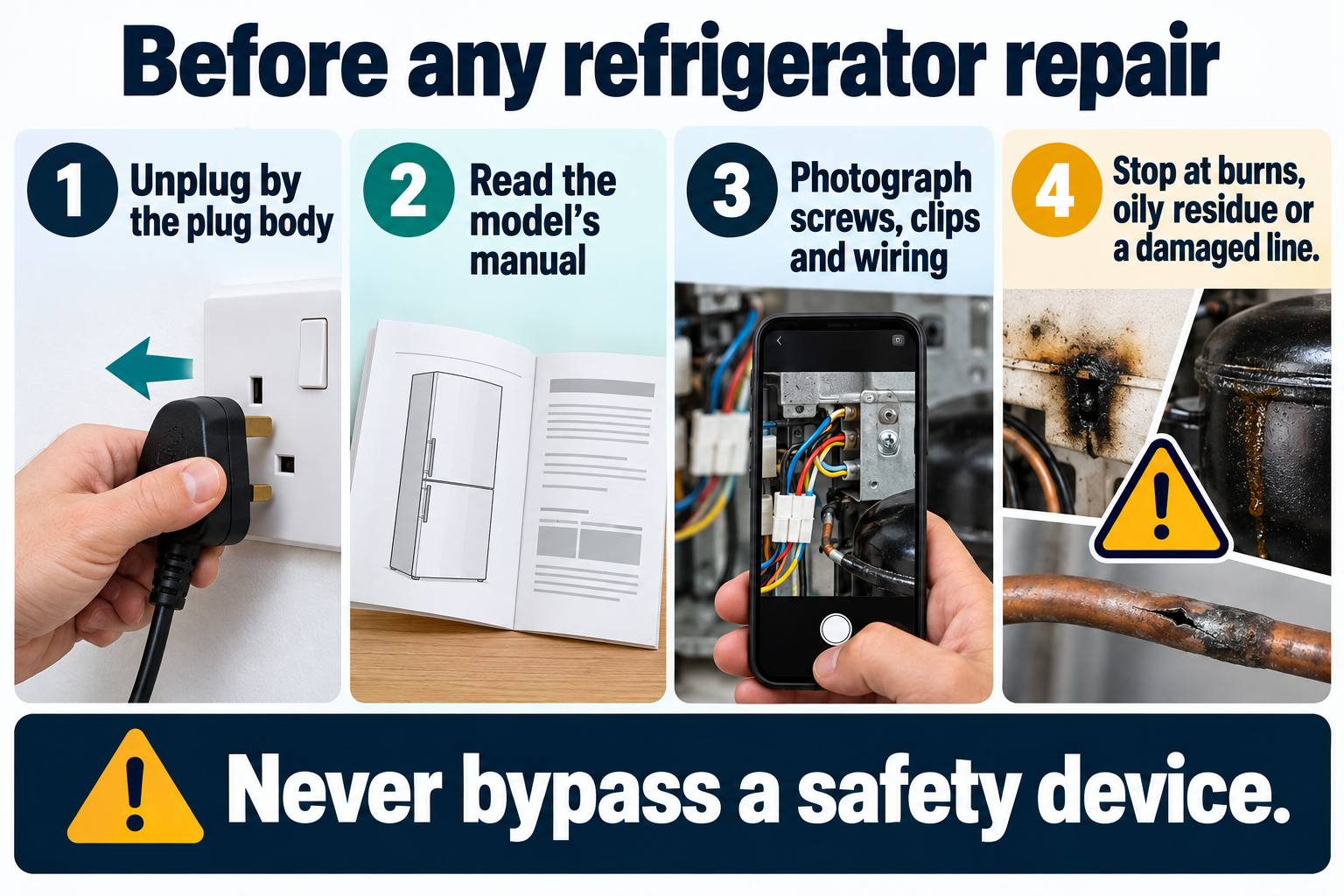
- Unplug the refrigerator by the plug body, and do not rely on a switch or a dark display.
- Read the manual for the model and for the job.
- Photograph the screws, the clips, the connectors and the wiring before you remove anything.
- Stop at the first burn mark, oily residue or damaged line, and call a technician.
Burn marks, a burning smell and recalls are covered in refrigerator safety hazards.
How Do Manuals and Wiring Diagrams Help?
The manual and the wiring diagram show how to open the unit and how the parts connect, and they match only the model number. The manufacturer support page for the model number lists the manual, and the model number is usually on a label inside the refrigerator compartment. A wiring diagram shows the circuit and does not make a live test safe. Do not use a diagram or a manual for another model.
Where do you find the wiring diagram?
Check the manual first, because some models include the wiring diagram on the unit and others supply it only in the service documents. The manufacturer support page for the model number says which documents exist.
How Do You Decide Between DIY and a Technician?
Choose DIY only when the job is on the DIY list and the manual covers it, and call a technician when you are unsure. A DIY repair saves the labor and the diagnostic fee, and a wrong repair adds the cost of the part and the technician’s visit. The cost drivers of a professional repair are in refrigerator repair cost. Confirm the fault before you buy or fit any part, because a part fitted for the wrong fault costs money and fixes nothing.
Does a DIY repair void the warranty?
It can, so read the warranty terms before you open a panel. Ask the warranty provider whether the job is allowed.
When Should You Stop a DIY Repair?
Stop a DIY repair and call a technician when you find burn marks, an oily residue, a damaged line or a fault that returns. A compressor that hums, clicks or fails to start is covered in refrigerator compressor problems, and it is not a DIY job. Give the technician the symptoms, the codes, the model number and every change you made. Stop and unplug the refrigerator if you smell burning, and read refrigerator safety hazards before you plug it in again.
What Do People Also Ask About DIY Refrigerator Repair?
Can I repair my refrigerator myself?
Yes for the jobs on the DIY list, and no for sealed-system work, refrigerant handling and live electrical testing.
What refrigerator repairs should a technician do?
A technician should do sealed-system work, refrigerant handling, compressor replacement, live electrical testing and control board diagnosis.
Is it safe to repair a refrigerator yourself?
It is safe when the unit is unplugged, the job is on the DIY list and the manual covers it, and not otherwise.
Is it cheaper to repair a refrigerator yourself?
A DIY repair saves labor and the diagnostic fee, and a wrong repair costs more, as explained in refrigerator repair cost.
Where do I find the manual or wiring diagram for my refrigerator?
The manufacturer support page for the model number lists the manual, and the model number is usually on a label inside the compartment.
Related refrigerator guides
US and UK refrigerant-work boundary
Home diagnosis must stop before opening, cutting or tapping the sealed refrigerant circuit. In the US, EPA Section 608 certification is required for work that could release refrigerant. In the UK, work on equipment containing F-gas requires the relevant qualification. Refrigerant type and local rules vary, so use a qualified refrigeration technician for sealed-system work.

Hi, I’m Ryan, a refrigeration engineer based in the UK Midlands. I’m passionate about engineering, technology, and understanding how things work, especially when it comes to heating, ventilation, air conditioning, and refrigeration systems.
I enjoy the hands-on side of engineering, from working with technical equipment to exploring practical solutions to everyday challenges. For me, engineering is more than just a profession; it’s about problem-solving, continuous learning, and developing valuable technical skills.
I also enjoy sharing glimpses of the engineering world through my Instagram page, @hvac.razza, where I showcase tools, equipment, and aspects of HVAC work.
Outside the technical side of things, I value genuine connections, meaningful conversations, and opportunities to learn from others. I’m always interested in connecting with people who share an appreciation for technology, practical skills, and personal growth.