

Refrigerator Start Relay: 5 Signs of Failure, 4 Test Steps and 5 Replacement Steps
What Does the Start Relay Do?
The start relay gives the compressor motor the extra current it needs to start and then drops out of the circuit. The part plugs onto the side of the compressor, often in one assembly with the overload protector. The overload protector cuts power when the compressor overheats or draws too much current. Brands also call the assembly the start device or the relay and overload. Two relay types exist. A PTC relay uses a heat-sensitive disc, and a current-type relay uses a coil and a switch. Both perform the same job. The correct part depends on the compressor, not on the refrigerator brand alone. A fault in either part stops the compressor, which mimics compressor failure, as explained in refrigerator compressor problems.
What Are the Signs of a Bad Start Relay?
Five signs point to a failing start relay.
- Repeated clicking every few minutes
- A compressor that does not start while the fans run
- Humming that stops after a short time
- A warm cabinet with no compressor sound
- Burn marks or a burnt smell at the relay
Clicking sounds are explained in refrigerator noises. A unit that does not start at all is covered in refrigerator not running or starting. Several of these signs also point to the compressor, so confirm the relay with the tests below.
What does the clicking come from?
The clicking usually comes from the overload protector opening and closing while the compressor tries to start. The pattern repeats every few minutes until the fault is corrected.
What does the humming mean?
Humming that stops after a few seconds means that the compressor receives power but fails to start, and the overload protector then cuts the power. A failed relay is one cause, and a failed compressor is another.
How do you tell a relay fault from a compressor fault?
Tests decide the answer, because the signs of the two faults overlap. A relay that fails a test or a new relay that restores starting confirms the relay fault.
Where Is the Start Relay?
The start relay plugs onto the compressor terminals at the rear or the bottom of the unit, usually behind a small cover. The compressor is the black metal dome. The manual shows the exact location and the panel to remove.
Safety notice: Unplug the refrigerator before touching any part at the back or the bottom. Stop at the steps described here. Electrical testing, refrigerant handling and sealed-system work belong to a technician.
Remove the rear panel or the lower cover as the manual directs. Find the small plastic cover on the side of the compressor. The relay and the overload protector sit under or beside it. Photograph the assembly before removing anything, so that the orientation and the wire positions are recorded. Difficulty: easy to moderate for access.
How Is the Start Relay Tested?
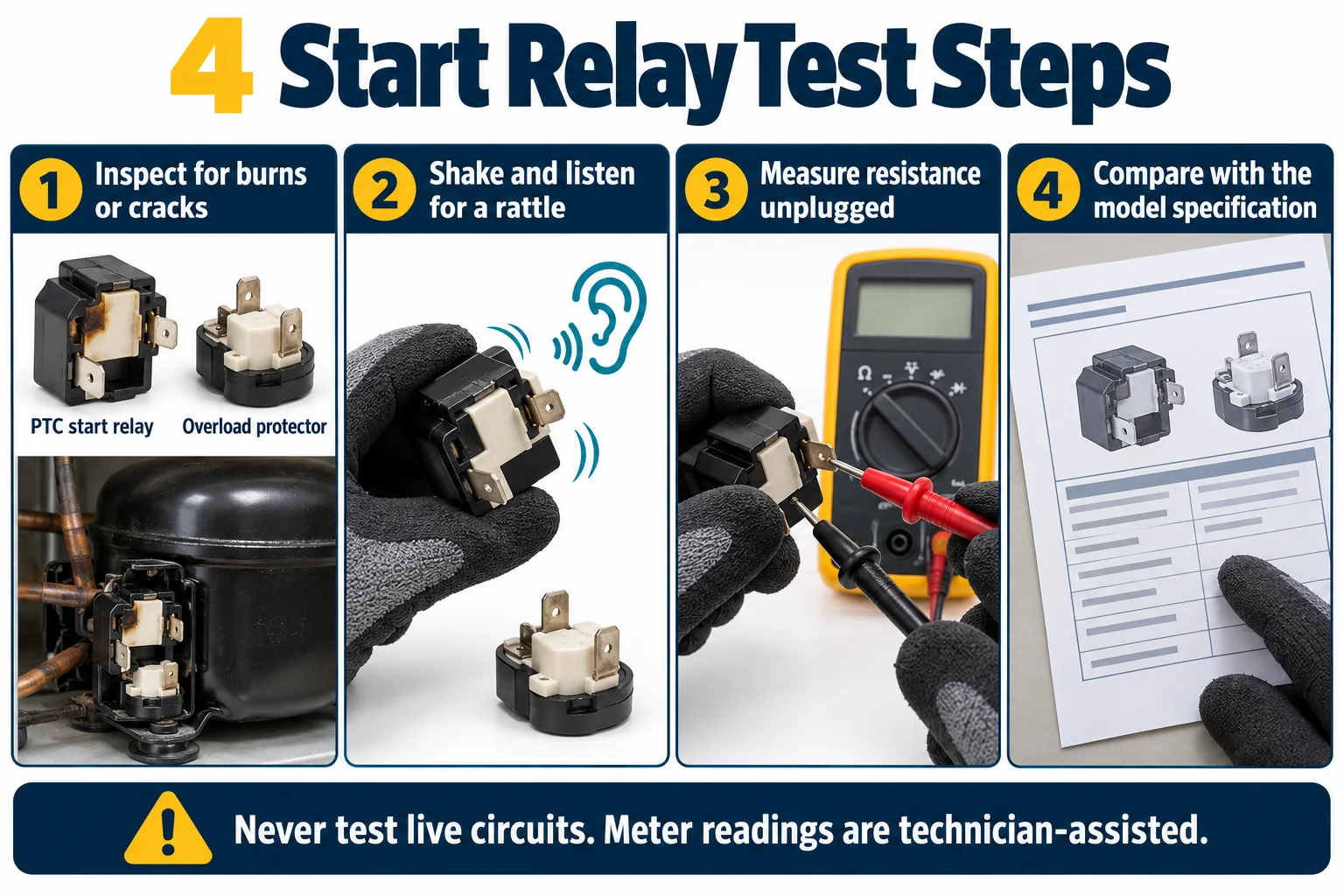
A relay test uses an inspection, a shake test and a resistance reading, and the reading is compared with the manufacturer specification. The tests are limited to the steps that a technician approves. Do not test live circuits at home.
- Inspect the relay for burn marks, a cracked case or melted terminals.
- Shake the relay and listen for a rattle.
- Measure the resistance across the relay terminals with a meter, with the refrigerator unplugged.
- Compare the reading with the manufacturer specification for the model.
Record each reading and the specification beside it, because the technician compares the record. A relay that passes the inspection and the shake test can still fail the resistance reading.
What does a visual inspection show?
Burn marks, a cracked case or melted terminals show a failed relay without any other test. Replace the relay and look for the cause of the heat.
What does a shake test show?
In many PTC-type relays, a rattle means that the internal disc has broken. A relay that rattles is replaced. Difficulty: easy.
What does a resistance reading show?
A reading outside the manufacturer specification means that the relay has failed, and an open reading means that no current can pass. A technician confirms the specification for the compressor, because each compressor uses a specific relay and only the manufacturer specification confirms the reading. Difficulty: technician-assisted.
Should the overload protector be tested too?
Test the overload protector in the same session, because it often shares the housing and a fault in either part stops the compressor. Replace each part that fails its test.
How Is the Start Relay Replaced?
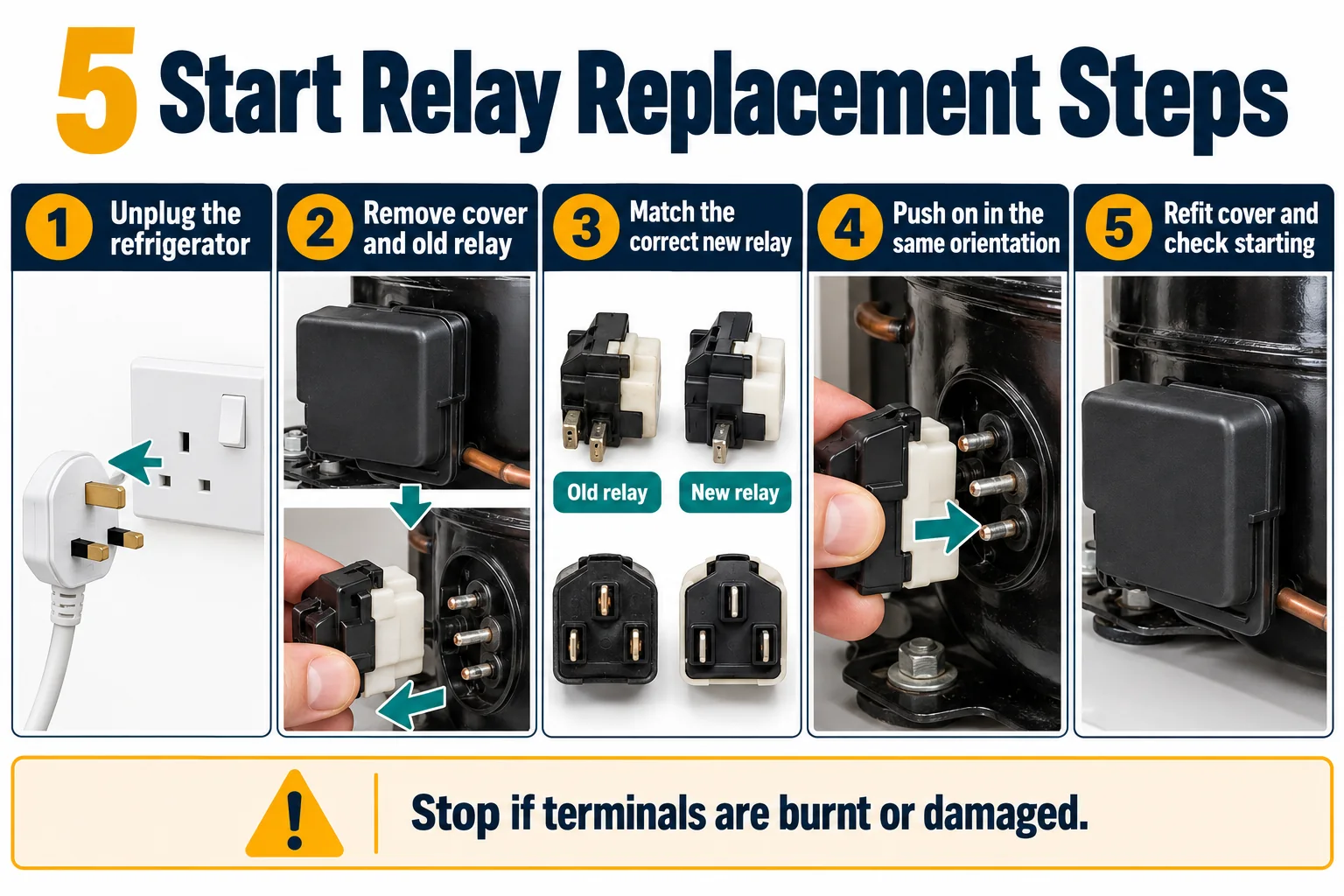
Replace the relay with the part that matches the refrigerator model number, because relays differ by compressor. Use the model-number part list in the manual or from the manufacturer, and compare the new relay with the old relay. Five steps complete the replacement:
- Unplug the refrigerator.
- Remove the cover and pull the old relay straight off the compressor terminals.
- Compare the new relay with the old relay and with the part list.
- Push the new relay straight onto the terminals in the same orientation.
- Refit the cover, plug in the refrigerator and listen for the compressor to start.
Check the terminals before pushing the relay on, because bent pins prevent a firm fit. Do not force the relay onto the terminals. Keep the old relay in a labeled bag, so that the technician can compare it if the problem remains. Record the date of the replacement. Call a technician if the terminals are burnt or the compressor housing is damaged. A relay costs less than a compressor, so a confirmed relay fault is the cheaper repair. Difficulty: moderate.
What if the Start Relay Is Fine?
A relay that passes every test points to the overload protector, the control board or the compressor. Rule out the power supply as well, because a weak circuit can stop a sound compressor from starting. The starting current is explained in refrigerator running amps and power draw. The compressor tests are covered in refrigerator compressor problems. Repeat the tests after any repair, because a second fault can hide behind the first. Record the readings for the technician. Call a technician when the relay, the overload protector and the supply all pass.
What Safety Notes Apply to the Start Relay?
Unplug the refrigerator before touching the relay, because the compressor terminals carry line voltage. Six rules apply:
- Keep the refrigerator unplugged during every test and replacement.
- Never test the relay with the refrigerator plugged in.
- Keep hands and the floor dry.
- Stay clear of the compressor while it is hot.
- Wear gloves, because panel edges can be sharp.
- Never open the sealed system or touch the refrigerant lines.
Keep children and pets away from the open rear of the unit. Return all covers and fasteners to their original positions before plugging in. Call a technician for burnt wires, burnt terminals or any damage to the compressor.
What Do People Also Ask About a Refrigerator Start Relay?
How do I know if my refrigerator start relay is bad?
A relay that clicks repeatedly while the compressor fails to start, or that rattles when shaken, is likely bad.
Can a bad start relay damage the compressor?
A failing relay can leave the compressor trying to start repeatedly, which strains it, so replace a failed relay promptly.
Can I replace the start relay myself?
A relay replacement is a moderate home repair when the unit is unplugged and the part matches the model number, and any electrical test belongs to a technician.
Why does my refrigerator click but not start?
Repeated clicking points to the start relay or the compressor, as explained in refrigerator compressor problems.
Related refrigerator guides

Hi, I’m Ryan, a refrigeration engineer based in the UK Midlands. I’m passionate about engineering, technology, and understanding how things work, especially when it comes to heating, ventilation, air conditioning, and refrigeration systems.
I enjoy the hands-on side of engineering, from working with technical equipment to exploring practical solutions to everyday challenges. For me, engineering is more than just a profession; it’s about problem-solving, continuous learning, and developing valuable technical skills.
I also enjoy sharing glimpses of the engineering world through my Instagram page, @hvac.razza, where I showcase tools, equipment, and aspects of HVAC work.
Outside the technical side of things, I value genuine connections, meaningful conversations, and opportunities to learn from others. I’m always interested in connecting with people who share an appreciation for technology, practical skills, and personal growth.