
Refrigerator Thermostat, Thermistor and Damper Problems: 4 Parts, 5 Failure Signs and 5 Checks
What Do the Thermostat, Thermistor and Damper Do?
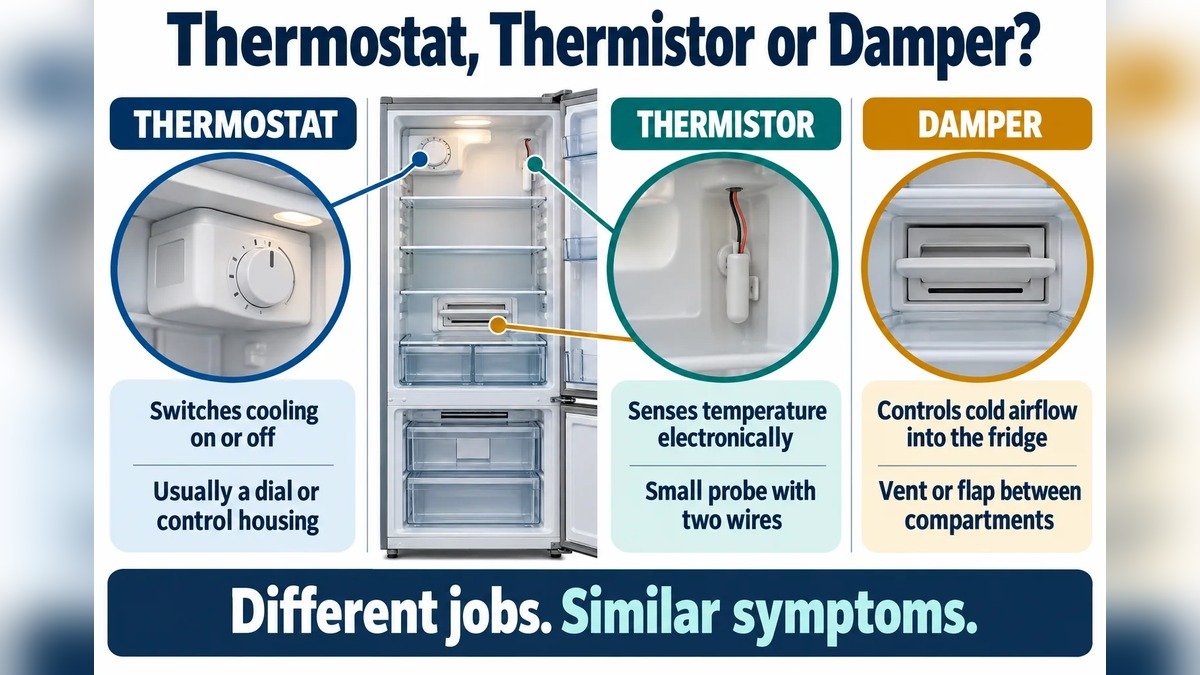
These parts decide when the refrigerator cools and how the cold air is shared between the freezer and the refrigerator compartment. A part that fails can leave the food too warm or too cold while the cooling system itself is sound. Weak cooling has other causes too, and they are in refrigerator not cooling. The manual for the model shows which of these parts the refrigerator has.
Where are the thermostat, thermistor and damper?
On many models they sit behind a panel in the freezer or in the air duct between the compartments, and the manual shows the positions. Do not remove any panel beyond the ones that the manual shows.
Which Parts Control the Temperature?
Four parts work together to hold the set temperature.
- The thermostat, a dial control that switches the compressor on and off by temperature on mechanical models
- The thermistor, a sensor whose electrical reading changes with temperature and tells the control board how warm a compartment is
- The damper, a flap that opens and closes to let cold air pass from the freezer to the refrigerator compartment
- The control board, which reads the sensors and switches the compressor, the fans and the heater
A fault in the control board gives similar signs, and the signs are in refrigerator control board failure signs.
Do all refrigerators have a thermostat, a thermistor and a damper?
No. Mechanical models use a dial thermostat, electronic models use thermistors and a board, and some models have no damper. The manual shows which parts the model has.
What Are the Signs of a Failed Temperature Control Part?

Five signs point to a failed temperature control part.
- The refrigerator compartment is warm while the freezer is cold
- Food freezes in the refrigerator compartment
- The compressor runs constantly, or it stops and starts too often
- The display shows a temperature that differs from a thermometer in the compartment
- A change of setting has no effect on the temperature
Several of these signs also come from other faults, so rule those out first.
Why is the freezer cold but the refrigerator warm?
A damper that stays closed can keep the cold air in the freezer, though a stopped fan or a blocked vent gives the same sign. Check the vents and the fan before you suspect the damper.
Why is the refrigerator freezing my food?
A damper stuck open, a thermostat stuck on or a thermistor that misreads can let too much cold air in. The other causes are in refrigerator too cold.
What Else Looks Like a Temperature Control Fault?
Several simple causes mimic a failed part, so rule them out before you suspect a thermostat, a thermistor or a damper. Food or ice blocking the vents, an overloaded compartment, a worn door seal, a setting that was changed, a hot room and a recent power cut all change the temperature. A stopped fan gives the same signs as a stuck damper. Clear the vents, check the setting and the door, and give the refrigerator time to settle before you decide.
How Do You Check the Temperature Controls?
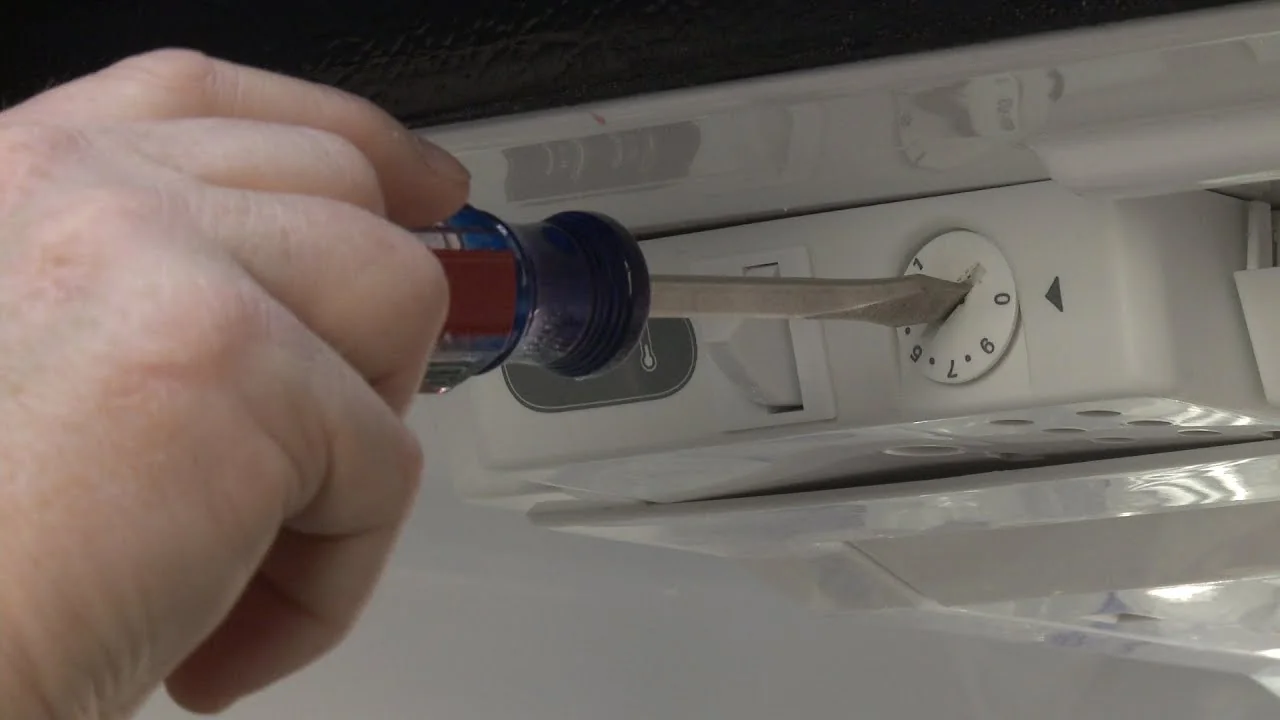
Compare a thermometer with the display, change the setting, clear the vents and note which compartment is wrong.
Safety notice: Unplug the refrigerator before touching any part behind a panel. Do not test a thermistor or a thermostat with a meter, because electrical testing, refrigerant handling and sealed-system work belong to a technician.
Five checks narrow the fault:
- Put an appliance thermometer in each compartment, and compare the readings with the display and the setting after several hours.
- Change the setting by one step, and watch the thermometer over the following hours to see whether the temperature responds.
- Clear food and ice away from the vents and from the opening between the compartments.
- Feel for airflow at the vents in both compartments, and listen for the fan.
- Note which compartment is wrong and whether the compressor runs constantly or stops and starts too often, and record it for the technician.
Photograph the display and the setting before you change anything. Difficulty: easy for the thermometer and vent checks, and technician-assisted when a part must be tested or replaced.
Can You Replace a Thermostat, Thermistor or Damper Yourself?
Replacement is technician-assisted, because a test must confirm the fault and the new part must match the model. A sensor or a damper that looks fine can still fail, and only an electrical test shows it. Do not buy a part until the fault is confirmed, because a part fitted for the wrong fault fixes nothing.
How do you find the right replacement part?
Use the model number, the manual and the manufacturer parts list, because a part for another model can differ in fit and rating. Do not rely on a part number from memory or from a different model.
What Happens If a Temperature Control Fault Is Ignored?
A warm fault spoils food, a cold fault freezes it, and a fault that keeps the compressor running wears it and raises the running cost. Food in a compartment that stays warm spoils faster, and food in a compartment that is too cold loses quality. Treat the fault as urgent, because the food and the compressor both suffer.
Is food safe in a refrigerator that is too warm?
Not when the compartment stays warm, so use an appliance thermometer and move perishable food to a cooler. Keep the doors closed while you wait for the repair.
When Should You Call a Technician?
Call a technician when the checks do not explain the fault, a setting has no effect, or you see damage or burn marks. If the checks find nothing, the other causes of weak cooling are in refrigerator not cooling, and a control board fault is covered in refrigerator control board failure signs. A part that must be tested, a damper that does not move and a sensor that misreads need a technician. Stop and unplug the refrigerator if you smell burning. Give the technician the symptoms, the thermometer readings, what you checked and the model number.
What Do People Also Ask About Refrigerator Temperature Controls?
What does a refrigerator thermistor do?
It is a temperature sensor whose reading tells the control board how warm a compartment is.
What does a refrigerator damper do?
It opens and closes to let cold air pass from the freezer into the refrigerator compartment.
How do I know if the thermostat is bad?
A setting with no effect, a compressor that never stops or food that freezes suggests a bad thermostat, and a technician must confirm it.
Why is my refrigerator too cold?
A stuck damper, a stuck thermostat or a misreading thermistor can let too much cold air in, and the other causes are in refrigerator too cold.
Can a bad thermistor cause weak cooling?
Yes. A thermistor that misreads can switch the compressor or the fan at the wrong time, and a technician must test it.

Hi, I’m Ryan, a refrigeration engineer based in the UK Midlands. I’m passionate about engineering, technology, and understanding how things work, especially when it comes to heating, ventilation, air conditioning, and refrigeration systems.
I enjoy the hands-on side of engineering, from working with technical equipment to exploring practical solutions to everyday challenges. For me, engineering is more than just a profession; it’s about problem-solving, continuous learning, and developing valuable technical skills.
I also enjoy sharing glimpses of the engineering world through my Instagram page, @hvac.razza, where I showcase tools, equipment, and aspects of HVAC work.
Outside the technical side of things, I value genuine connections, meaningful conversations, and opportunities to learn from others. I’m always interested in connecting with people who share an appreciation for technology, practical skills, and personal growth.