
Refrigerator Door Seal and Gasket: 5 Warning Signs, 4 Tests and 6 Replacement Steps
What Does the Refrigerator Door Seal Do?
The door seal, also called the gasket, closes the gap around the door so that warm room air stays out and cold air stays in. On most models a magnet in the seal pulls the door tight against the cabinet. A worn seal lets warm air leak in, so the refrigerator runs longer and the compartments warm. A leaking seal is one cause of weak cooling, and the other causes are in refrigerator not cooling.
What Are the Signs of a Worn Door Seal?
Five signs point to a worn door seal.
- The door does not close fully, springs back open or sags
- The seal has gaps, tears, cracks or hard, flattened sections
- Mold or dirt sits in the folds of the seal
- Frost or condensation builds near the door edge
- The refrigerator runs longer than usual or the compartments warm
Several of these signs also come from other faults, so test the seal before you buy a new one.
Can a worn door seal make a refrigerator run constantly?
Yes. Warm air leaks in, so the compressor runs longer to hold the set temperature. The other causes of constant running are in refrigerator running constantly.
Can a worn door seal cause frost?
Yes. Warm, moist air that leaks in freezes on the cold surfaces and builds frost near the door. The other causes of frost are in refrigerator frost problems.
How Do You Test a Refrigerator Door Seal?
Test the seal with a look, a paper strip, a flashlight and a door swing check before you replace anything. Four tests check the seal:
- Look all the way around the seal for tears, gaps, cracks, hard or flattened sections and mold in the folds.
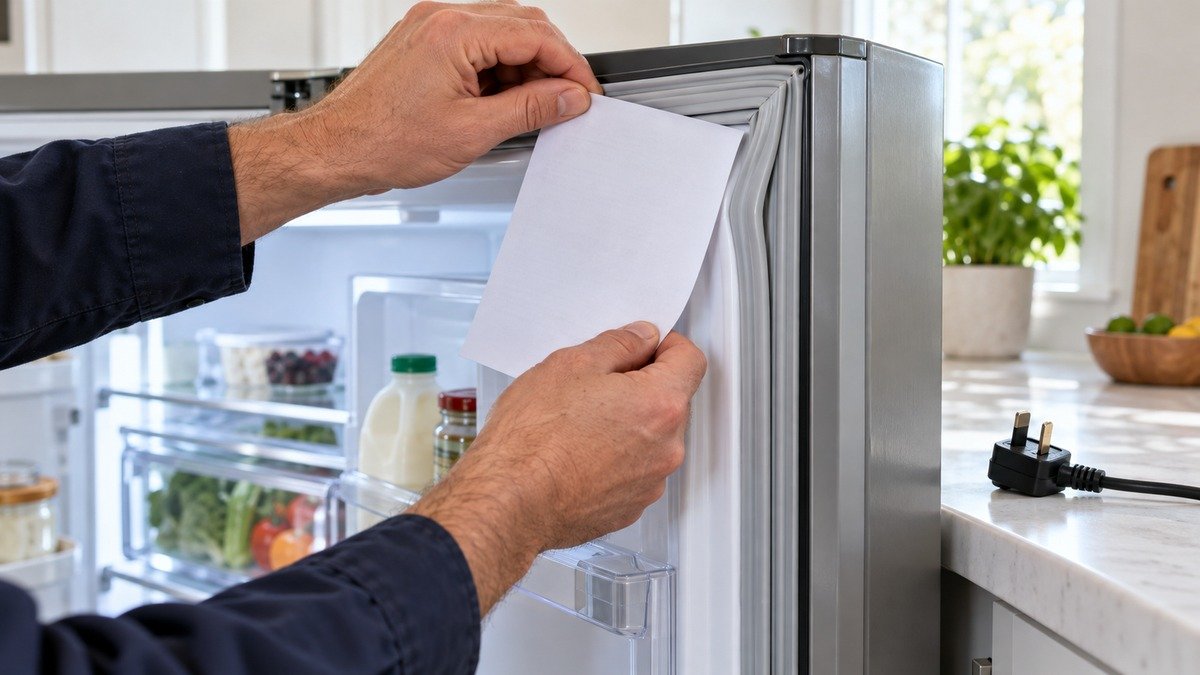
- Close the door on a strip of paper or a paper strip or banknote and pull it out gently, because a good seal grips the strip and a strip that slides out freely marks a leak.
- Put a flashlight inside the compartment, close the door in a dark room and look for light around the door edge.
- Swing the door gently and check that it closes by itself, latches and sits flush against the cabinet.
Repeat the paper test at several points around the door, because a leak at one corner can hide behind a good seal elsewhere. Difficulty: easy.
What Else Looks Like a Worn Door Seal?
A door that is out of line, a blocked door or a dirty seal can leak air even when the seal is sound. Food or a bin that sticks out can hold the door ajar. A seal that is only dirty or sticky needs cleaning, not replacement. A cabinet that is not level can leave a gap at one corner, so check the level before you blame the seal.
Why does the door sag or not close?
A loose hinge, an unlevel cabinet or a heavy load in the door bins can pull the door out of line. Check the level and the bins first. A door that stays out of line after those checks needs a technician.
Should You Clean or Replace the Door Seal?
Clean a dirty seal first, and replace it when it is torn, hard or flattened, or when it still fails a test after cleaning. A torn or hard seal no longer closes the gap, and cleaning does not restore it. A clean seal that passes the tests needs nothing more.
How do you clean a door seal?
Wash the seal with mild soap and warm water, rinse it, dry it and check the folds for mold. Avoid harsh cleaners, which can harden the rubber, and keep sharp tools out of the folds.
Which Door Seal Does Your Refrigerator Need?
Most seals press into a groove around the door or fit under a retainer strip held by screws, and the manual shows which. A seal for another model can differ in size and shape and will not close the gap. Record the model number before you search for the manual.
How do you find the right replacement seal?
Use the model number and the manufacturer parts list, because each door can need its own seal. Do not rely on a part number from memory or from a different model.
How Do You Replace a Refrigerator Door Seal?
Order the seal for the model, remove the old seal, clean the groove, fit the new seal evenly and repeat the paper test.
Safety notice: Unplug the refrigerator before you remove any screw or strip. Do not use a blade near the door liner, and do not heat the seal with a flame or a heat gun. Electrical testing, refrigerant handling and sealed-system work belong to a technician.
Six steps replace the seal:
- Get a seal made for the model, and read the manual for the type of fitting.
- Empty the door bins, move perishable food to a cooler and unplug the refrigerator.
- Photograph the old seal, then pull it from the groove or loosen the retainer screws and lift it out.
- Wash the groove or the door liner with mild soap and warm water, and dry it.
- Fit the new seal at the top corners first, then press or tuck it in all the way around, or slide it under the retainer strip and tighten the screws as the manual states.
- Close the door, check the corners for gaps, repeat the paper test, plug in the refrigerator and watch the temperature over the following hours.
Do not stretch the seal while you fit it, because a stretched seal leaves gaps at the corners. Difficulty: moderate, because the seal must sit evenly all the way around.
When Should You Call a Technician?
Call a technician when a new seal still leaks, the door will not close or hangs crooked, or the hinges or the door are damaged. If the seal is sound, the other causes of weak cooling are in refrigerator not cooling. A door that is out of line, a bent door or cabinet and a torn liner near the seal need a technician. Give the technician the symptoms, the results of the tests and the model number.
What Do People Also Ask About Refrigerator Door Seals?
How do I know if my refrigerator door seal is bad?
Gaps, tears, hard sections, mold, frost near the door edge or a failed paper strip test point to a bad seal.
How do I test a refrigerator door seal?
Close the door on a strip of paper or a paper strip or banknote and pull gently, and a strip that slides out freely marks a leak.
Can a bad door seal cause a refrigerator to run constantly?
Yes. Warm air leaks in, so the compressor runs longer, as explained in refrigerator running constantly.
Can a bad door seal cause frost in the freezer?
Yes. Warm, moist air freezes on the cold surfaces, and the other causes are in refrigerator frost problems.
Can you replace a refrigerator door seal yourself?
Yes, when the new seal matches the model, the refrigerator is unplugged and you accept a moderate job.
Related refrigerator guides

Hi, I’m Ryan, a refrigeration engineer based in the UK Midlands. I’m passionate about engineering, technology, and understanding how things work, especially when it comes to heating, ventilation, air conditioning, and refrigeration systems.
I enjoy the hands-on side of engineering, from working with technical equipment to exploring practical solutions to everyday challenges. For me, engineering is more than just a profession; it’s about problem-solving, continuous learning, and developing valuable technical skills.
I also enjoy sharing glimpses of the engineering world through my Instagram page, @hvac.razza, where I showcase tools, equipment, and aspects of HVAC work.
Outside the technical side of things, I value genuine connections, meaningful conversations, and opportunities to learn from others. I’m always interested in connecting with people who share an appreciation for technology, practical skills, and personal growth.