

Refrigerator Size, Capacity and Weight: 6 Measurements, 5 Fit Checks and 4 Delivery Steps
What Do Refrigerator Size, Capacity and Weight Mean?
Size is the outside dimensions, capacity is the storage volume inside and weight is what you must lift, so each one answers a different question. The cabinet walls, the insulation and the cooling parts take space, as refrigerator parts explains, so the capacity is less than the outside size suggests. This page gives no dimensions, capacities or weights from memory, because the spec sheet for the exact model sets them.
Take the outside dimensions, stated capacity and net weight from the exact model’s current specification sheet. Do not substitute figures from a similar-looking model or from a different regional version.
Why is the capacity smaller than the outside size suggests?
The walls hold insulation and the cooling parts take space, so the usable volume is less than the cabinet size. Shelves and bins also take space, so the stated capacity may not match what you can store.
Which Measurements Decide Whether a Refrigerator Fits?
Six measurements decide the fit, and you need every one before you buy or move a refrigerator.
- The height of the cabinet with the hinges and the top fittings
- The width of the cabinet
- The depth of the cabinet with and without the handles
- The space that the doors need to swing open
- The clearance for airflow at the back, the sides and the top
- The width of the path from the door to the space, with every turn
Where do you find the dimensions for your model?
The spec sheet or the manual for the exact model number states them, and the label inside the refrigerator gives the model number. Photograph the label once you find it.

How Do You Check That a Refrigerator Fits the Space?
Compare the measurements of the space with the dimensions of the model, and add the clearance that the manual states. Five checks decide the fit:
- Take the dimensions for the exact model from the spec sheet or the manual.
- Measure the height, the width and the depth of the space, and note any shelf, pipe or wall that limits it.
- Add the airflow clearances stated in the exact model’s installation document at the sides, back and top; there is no universal clearance for every refrigerator.
- Check that the doors and any drawers can open fully without hitting a wall or a cabinet.
- Record the measurements, and compare them with the model before you buy or move.
Difficulty: easy.
Does a tight space affect the cooling?
Yes. A refrigerator without room for airflow runs warmer and works harder, and the cooling can weaken, as explained in refrigerator not cooling.
How Do You Read a Refrigerator’s Capacity?
The spec sheet states the capacity as the total storage volume in cubic feet, and it often splits it between the refrigerator and the freezer. Compare the stated capacity with how much you store, because the usable space also depends on the shelves, the bins and the layout. Match the capacity to the household and the room.
Is a bigger capacity always better?
No. A larger refrigerator needs more space and can use more power, so match the capacity to the household and the room.
How Do You Plan the Delivery and the Move?
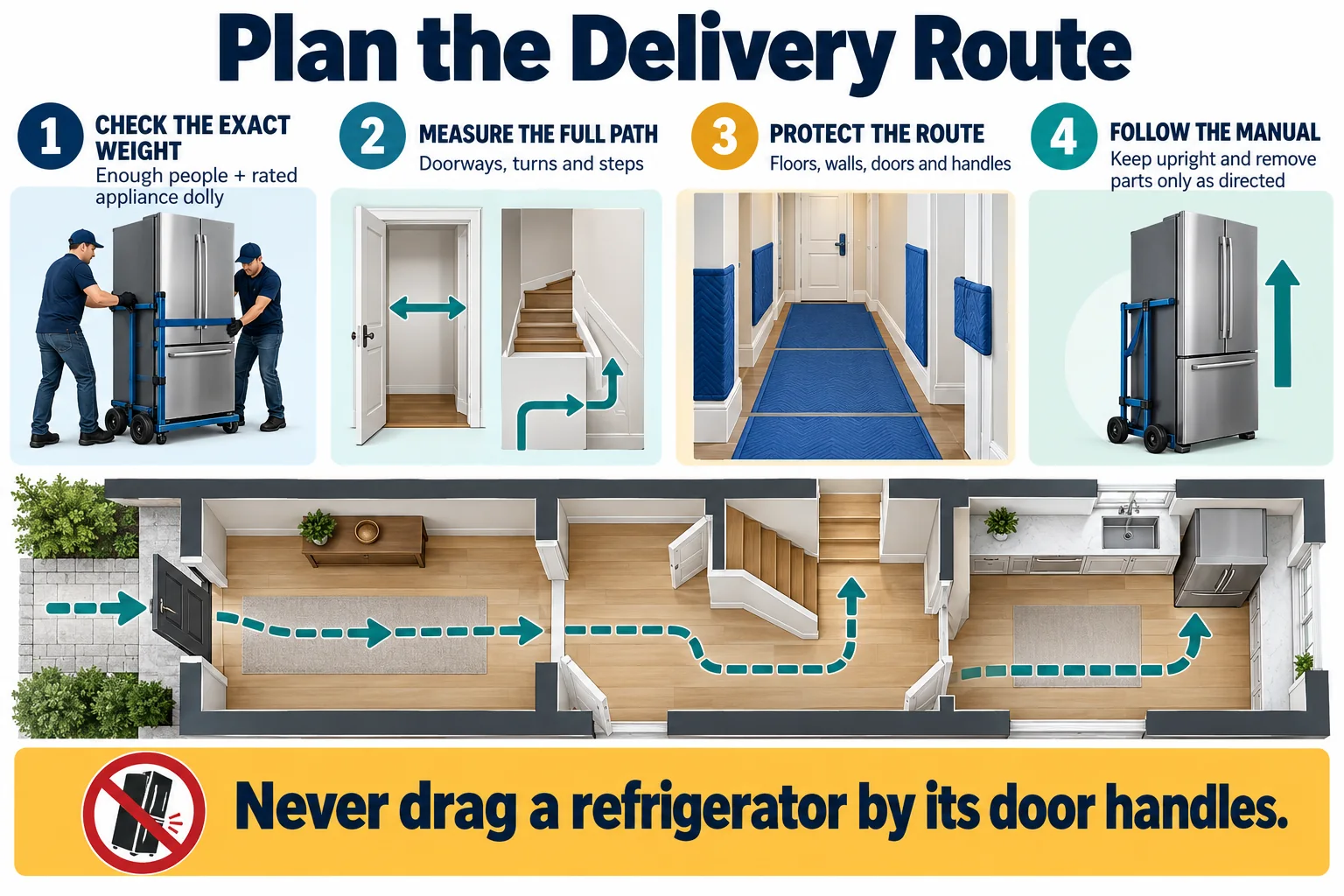
Plan the weight, the path and the position before the day, because a refrigerator is heavy and awkward to turn in a doorway. Use the exact model’s stated net weight and moving instructions, including any requirement to keep it upright, secure the doors or remove parts before transport.
Safety notice: A refrigerator is heavy, so use enough people and a rated appliance dolly, and keep fingers clear of the doors and the hinges. Unplug the refrigerator before you move it, and do not drag it by the door handles. Electrical testing, refrigerant handling and sealed-system work belong to a technician.
Four steps plan the move:
- Find the weight on the spec sheet for the exact model, and plan enough people and a rated appliance dolly.
- Measure the path from the door to the space, with the doorways, the turns and any steps, and compare it with the dimensions.
- Remove a door or a handle only as the manual shows, and protect the floor and the walls.
- Keep the refrigerator upright as the manual states, and read the guidance in refrigerator startup before you plug it in.
Difficulty: moderate, because the refrigerator is heavy, and technician-assisted if a door or a water line must be disconnected.
Should you lay a refrigerator on its side to move it?
Only as the manual allows, because the position can affect the sealed system, so keep it upright when you can.
What Should You Check Once the Refrigerator Is in Place?
Check the level, the clearance, the doors and the water line before you plug in and load the refrigerator. Look that the refrigerator stands level on its feet, that nothing blocks the airflow at the back, the sides and the top, and that each door and drawer opens fully. Check that any water line is not kinked or crushed. Then follow the startup guidance for the model before you load it with food.
Why does the refrigerator need to be level?
A refrigerator that is not level can rattle and its doors can close badly, so level the feet as the manual shows.
What Should You Record Before You Buy or Move a Refrigerator?
Record the model number, the dimensions, the measurements of the space and the path, and the clearances, because they decide the fit. Photograph the label and the space. Keep the purchase record, because warranty terms differ and a claim needs the model number and the proof of purchase. Ask the seller or the warranty provider to confirm the cover in writing, and read the terms for the part and the labor before you book.
When Should You Call a Technician or a Delivery Team?
Call a delivery team or a technician when the path is tight, a door must come off or the cooling fails after the move. A water line that must be disconnected, a compressor that is loud, hot or clicking, an oily residue and any sealed-system fault need a technician. Stop and unplug the refrigerator if you smell burning. Give the technician the model number, the symptoms and what you checked. Under warranty, call the manufacturer first, because the warranty terms decide who may repair it. Otherwise, ask for a written quote that names the fault.
What Do People Also Ask About Refrigerator Size and Weight?
How big is a refrigerator?
Sizes vary by model, so use the spec sheet for the exact model, and the sourced figures are in the first section.
How do I measure a refrigerator for a space?
Measure the height, width and depth of the space, add the airflow clearance and check the door swing, as the five fit checks show.
What takes up the space inside a refrigerator?
The insulation, the cooling parts and the shelves take space, as explained in refrigerator parts.
How long should I wait before plugging in a moved refrigerator?
Follow the manual for the model, and read refrigerator startup for what to expect.
Why is my refrigerator not cooling in a tight space?
A space without airflow can weaken the cooling, as explained in refrigerator not cooling.
Related refrigerator guides
US and UK measurement units
Record dimensions in both inches and centimetres, capacity in cubic feet and litres, and weight in pounds and kilograms. Use the model data sheet for exact cabinet, door-open, hinge and handle dimensions; nominal widths are not installation measurements.

Hi, I’m Ryan, a refrigeration engineer based in the UK Midlands. I’m passionate about engineering, technology, and understanding how things work, especially when it comes to heating, ventilation, air conditioning, and refrigeration systems.
I enjoy the hands-on side of engineering, from working with technical equipment to exploring practical solutions to everyday challenges. For me, engineering is more than just a profession; it’s about problem-solving, continuous learning, and developing valuable technical skills.
I also enjoy sharing glimpses of the engineering world through my Instagram page, @hvac.razza, where I showcase tools, equipment, and aspects of HVAC work.
Outside the technical side of things, I value genuine connections, meaningful conversations, and opportunities to learn from others. I’m always interested in connecting with people who share an appreciation for technology, practical skills, and personal growth.